Saturday, July 16, 2016

New dollye on eBay this week!

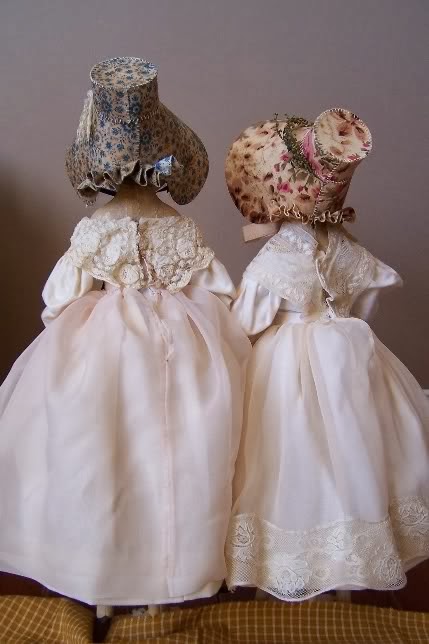
Queenie
My Love is on eBay this week~ if you would like to meet her, you can visit her 

Friday, July 15, 2016

Exploring an1820 Mache Doll

Welcome home M'Ladye~

  This new Ladye has found her way here to her new forever home. She is huge~ 26" tall, and all original on her kid milliner's model body, and I just couldn't be more excited to share her with you all~
 Upon her arrival, as the tea was brewing for our long awaited chat, as she stepped out of her traveling carton.... oh no! What is this I see gently sifting down from her skirts?  Poor girl is a trail of wood chips leaking from her detached legs! So instead of a single hello greeting, she has agreed to let you all follow along as we carefully remove her many layers to repair her legs~ a common problem with this early type of body. So check back often for a very special journey to meet this Grande Ladye~

Tuesday, July 12, 2016

New Dollye coming to eBay soon!

Beauty....Grace....Innocence 
 Queenie is tying her lace, getting ready to greet you soon on eBay. 
I. L.O.V.E. this. doll.
And I think you will too
 ~from my little worlde to yours~

Monday, July 11, 2016

Museum Monday

1850-5 Embroidered Black velvet Mantilla, 31.1998.15
  If you were a fashionable young ladye in the mid 19th century, to keep up with all  the latest fashions, there was no greater an anticipated arrival...well, other than ones beau, than the latest edition of Godey's Lady's Magazine. Of coarse there were others....World of Fashion, Sartain's, Petersons, Akermann's Repository ...but Godey's was the most popular and widespread fashion publication here in the US. It came out monthly, and along with stories there were recipes, music, current events, ideas for household amusements, embroidery and craft patterns....and at the very back, before the advertisements, usually 2 hand colored fashion plates and several pages of engravings of the latest styles. They were highly coveted by those that were fortunate to subscribe. Ladies would save them up and take to the book binder to have bound into book volumes. Above is the latest style of mantilla 'The Andalusia" ,  which bears close resemblance to this weeks Museum Monday lucky number 31!
  This piece holds a special place in my heart, as one of the first permanent pieces in my collection. I used to run an ad in the paper when we lived in Maine for any old clothings, and was offered this piece from its original family in Machias, Maine.  Its hand stitched of plush black silk velvet, with allover black silk embroidery and fringes, center front hook/eye closure and lined in a quilted silk wadded with wool, making it the perfect covering for a walk in the brisk fall air.
  The black is very hard to photograph, but there are separate pagoda sleeves set in very low~ there is absolutely NO picking up ones arms in this! Any bending of the arm or movement was done from the elbow down.
 While the back is not cut in quite as deep of a V as the Raglan , above, it does have the same long fringe treatment....so our mantilla is rather a hybrid of the Andalusia & the Raglan. Let's see what the September 1855 issue of Godey's has to say about the Raglan....

 " As the approach of the cold weather will render our Lady friends thoughtful about their winter garments, they will, we trust,  be grateful to find that we are at pains to afford them all the information in our power as to the several styles which the modistes of Paris have prepared for the season. 
   We commence with a beautiful article fashioned of royal purple velvet. It adjusts itself to the figure closely as far as the waist, thus presenting a remarkably elegant contour; three fold box pleats start from this point with fine effect; the balance of the skirt sweeps in a circular manner forward, over and in advance of the arm at the bend of the elbow, thus forming a covering for it. The front falls in tabs cut nearly square, but rather drooping towards the forward edge. The manner in which the trimming ornaments the upper portion will be understood at a glance; it is arranged similarly in front. We need scarcely observe that it is composed of a rich guipure lace with massive fringe. The lining is of satin, beautifully quilted in an elaborate design."

 Our mantilla does not have any lace, and here, you can see the embroidered sleeve~ its set into the body of the coat right at the fringe there. The shine of the black silk embroidery, along with the pattern itself, has the look of lace against the deep pile of the black velvet.
 From afar, the embroidery really looks like a lace flounce
Padded satin stitch, chain stitch, french knotts were worked to make this beautiful design, similar to many published each month in Godey's...which I think, is just as entertaining to read today, as it was 161 years ago!

Friday, July 08, 2016

New Blackwork Thread Palette Set

Hand Painted 17th c Blackwork
 Recently a customer ordered a set of slate frames and when I asked how she wanted them painted, she said "Paint whatever makes you happy". Is that awesome or what??  I have always loved blackwork embroidery~ the early 17th c style~ not the cross stitch that folks think of today that is labeled as such. Early blackwork is basically done in outline stitch, with any shading done in speckling or fil turk. If you have followed my blog for some years...you may remember I did an inked jacket based on this coif quiet a while ago. Along with this coif, the V&A has several fragments of what is believed to be a jacket, in same pattern. I drafted my own version of the pattern using all the pieces and some others found held privately. I have wanted to make a painted version for f-o-r-e-v-e-r...and so, I took the opportunity to paint up a blackwork slate frame.
 The design is first drawn on by hand with india ink using a dip pen...(did you that steel tip pens were in use in the early 1720s?.....most think of them as replacing quills in the late 19thc)
 After I have the outlines on, then I go back and add black shading~ I really love how it came out...I think an entire box would look stunning! The slat on the bottom is without shading, the top slat is finished.
 I left all the pictures large on this post today, so you can click on them to see details easier~ This is a large frame, and looks quite nice just hanging out when not in use. I am totally jealous of my customer having a blackwork frame and I think I may need to paint me one....in the mean time, I made up a thread palette set~
  using a fragment of same pattern~ I think a must have for anyone who loves blackwork embroidery!  If you are interested in it, or would just like to see more pictures~ it is available on eBay this week here .


Tuesday, July 05, 2016

Museum Monday!

Girls Corded Cotton Poke Bonnet c1820-40, 14.1997.6
 This week's Museum Monday lucky number is 14!  When one say's 'Poke Bonnet', I have found most folks will immediately think of the stiff straw types, ornamented with flowers and ribbons and lined in silk. Did you know they were very popular as sun bonnets? Some really quite deep, the simple cotton holding its shape with a starch stiffening. These bonnets were lightweight and cool in the summer, and white seems to be a popular choice over prints...perhaps because white reflects the heat away from the wearer...or  that they could be easily boiled and washed....or a little of both. This example, for a child, has another common component of these sun bonnets, a long neck bavolet, or ruffle, that would keep the sun off the wearers neck. Unlike today, it was not a welcome thing to have tanned skin....one of the first signs of a 'ladye' was her pale white, unblemished complexion.
 These bonnets extend out from the face, hense the name 'poke bonnet', (because one had to poke their head in there for the wearer to see them), and thus offered the wearer a bit of a sun shade....I like to think of them as the Grandmother's to the modern ball caps that everyone wears around today....
 The date is a broad one on this piece, the extra fine stitching and double ruffle around the front scream 1820's.. the double ruffle with its rolled hems is quite popular in 1820's era gowns, like several I have here in the collection.
 Entirely hand stitched and corded with 6 strands of cotton string in each channel. The channels made by taking up a little tuck in the fabric, then running the string thru each one. These provided another layer of stiffening, with four rows of cording around the front to help the bonnet to keep from collapsing in on the wearer.
I'd much rather wear one of these, than a ball cap....

Sunday, July 03, 2016

God Bless America