Showing posts with label Museum. Show all posts

Tuesday, November 19, 2024

November

  Back Burners

My sincere apologies for letting the blog sit for months now with nothing nice to read. I do get to my Instagram more, because it is quicker I guess, but that's no excuse. I have had more bad days than good, everything is a struggle for me, its been hard to juggle everything. More than just the blog has been put on the back burner...but hey, they're not off the stove entirely so I guess that is a good thing. 
 I have been getting little things done here and there, and this past week I came to the blog for something and saw it has been so long since I have posted(!!) and that's just unacceptable to me! 

One of my back burner to-do's was making an archival mount to store of the many 18th c quilted layette basket linings in the collection. I do have one still stitched into its original 18th c woven basket, but the others are long separated from theirs. This lining in particular was stored for years before I got it folded and by how sharply the folds were creased I suspect this was placed on the bottom of the stack and under much weight. Silk does not like to be folded. It really needs to be stored flat and not folded, but because it is a shaped construct, it does not just open up and lay flat. 

I took careful measures and made a basket /tray form from archival materials to store it, as seen above. Ideally, I will have triangular inserts that fit up against all sides that will fully support the silk ruffle as well. 

I am always looking for deals, and this past summer had a couple of happy finds. One was this table, 50 dollars in a junk shop I found while waiting for daughter to get out of school up in Pueblo..


I brought it home and refinished it. It's a great little table, better than anything you can get new these days. One of my favorite things about it is the hand made cove/ridge molding around the table edge, its wavy and wonderful. 

Can you believe these were not even 50 dollars?! Colonial shoes, thats what they were sold as, 49 bucks. Not in the greatest shape, but ya'll know how much I love shoes. Even the poorest condition pieces are valuable, as we can see construction details not seen in pristine ones. This is them out of the ENVELOPE they were mailed to me in (oh my golly I am never amazed at how people ship things)

 I was absolutely over the moon when I removed the olde paper stuffing and found the provenance of the shoes written on the footbed and interior of both latchetts of one of the shoes. Grandma may no longer be with us, but her wedding shoes are, and they cannot wait to help me uncover her story.

All these need is a little love to bring them back to life. 

One more happy under 50.00 find of the year...this one just 33.00 on eBay

 A precious boys wool tunic late 1830s to very early 1840s I thought...and upon unwrapping it when it came, not one but two provenance notes along with a museum loan document it being worn in 1840 in New York.

I love the neoclassical design of the applied braid on the front. 
I would have loved to have the matching trousers that there most definitely once was, but hey, beggars can't be picky. I'll take it how it is, with gratitude!


Saturday, August 19, 2023

Plaid Plaid Plaid

Late 1830s Boy's Fall Front 2pc. Suit

Say hello to our new little friend. I apologize that I did not catch his name, as he does not speak...but he is in there to be sure.  This is a fabulous example of boy's wear of the 1830s for several reasons. It fits into so many different categories, yet, it does not. Boys clothing is always super rare...young man's clothing moreso. Is this toddler-size? No. Is it young man size? No. I'd say grade school, between being breached and yet before 'adult' style of clothing was worn. Is this a skeleton suit? Well...not exactly. Is it a relative? definitely. Boys at this time would have worn a straw hat to keep the sun off and their heads covered...not this beaver type I have on him. But since I don't have an early boy's straw hat in the collection, and I do have a beaver...he chose to wear the beaver. Would he have worn shoes??? Maybe not. 
The suit is made from a lightweight cotton or linen blend plaid, very summer weight. I love early group images as they provide evidence of how current fashions were worn. There are always some who were more fashionable and some who were less...sometimes some eccentric folks, all together in the same picture. The above set of boys are from the late 1850s, not one is wearing shoes.

Here is a nice 1850s school group of girls and boys, with their teachers....if you click and zoom in, some of these boys aren't wearing shoes either...
I digress...why am I talking about the habit of not wearing shoes instead of this suit? It is hard to not sit and daydream about what little chap would have worn it, where did he live? Did he live long? Have a happy life? Grow up to have his own little boy? Sadly, the odds are not in his favour. Clothing such as this usually only survived because it was the little guy's last set of clothes before he passed away, for whatever reason. Otherwise, they were worn until they were worn out, handed down, etc etc. 

Here is a back view, an arm has slipped out of the pocket now.  This is a two-piece suit consisting of a one-piece skeleton and an outer jacket. I date it firmly to the late 1830s from the fall front, a staple on grown men's pants at the time period, the banded-down sleeves, and the ruffle around the hem of the jacket. Younger boys at this point in time would have worn fuller skirts on their jackets, reaching down to the knees. Our lad here is older, he's grown up enough to just have a little hint of the skirts left at the hem of his jacket, in the form of a ruffle. 

This back view shows the jacket removed. You can see the fullness in the booty area to allow him to comfortably bend over and not get, ahem... a 19th c wedgie. There are three buttons that close the back upper. The bottommost button also buttons onto the waistline of the pants, along with 4 additional buttons, two on each side.  They are not visible in this photo, but there are yet more buttons down the sides to allow the back flap to be undone for him to go to the outhouse and not have to take his entire ensemble off, as seen below.


Enjoy this pic~ take a few moments to soak it all in. A fall front flap on such a small child's garment. ::::sigh:::::
Two buttons attach it at the waistline, and there is also a  large side opening pocket to each side of it~ cause hello, boys need space to put things!
The only lining in the entire garment is the linen lining to the body of the jacket as seen above, it does NOT extend into the sleeves.

With the jacket on, the front flap reaches just up under the jacket's waistband.

This is a view of the inside of the front of the suit~ the plaid material extends into the front flap area fully~ so that when the flap is down, he is still covered somewhat. The two ample pockets can be seen....no doubt they once held marbles and all sorts of fun stuff!


Friday, February 18, 2022

Don't Forget ....

 Your Wallet!

I'll be on my way to Colonial Williamsburg this next week and am thinking about what bags I need to drag out from the depths of the closet. I almost can't remember the last time I flew someplace. It would be so much easier to open the drawer and pull out a few wallets instead. Much softer. Much more portable! I bet if I asked you what an 18th c wallet looked like you would describe a tri-fold shaped object made of leather, or perhaps even linen, and possibly decorated with flame or tent stitch embroidery.  

Nope. That's more of a pocketbook, not the huge linen gorgeousness seen below. 


Often referred to nowadays as a 'Market Wallet', in the 18th c and before, it was simply called a wallet or bag.  They are somewhat rare, being such a utilitarian object. Of course, that is what really attracts me to add objects to my collection. I like the common everyday use things that weren't saved because they got used until they fell apart, and then their parts were reused for other things. 

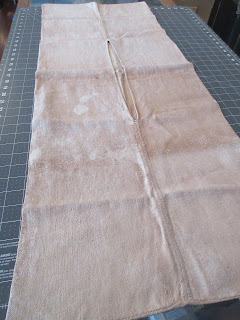
Just look at the expanse of good linen there is here! I have photographed it on a cutting mat marked with one inch squares. It measures 15" across, and 39" long.  The center opening is 14" long.  I can think of a million things I could make out of this wallet, especially since it is constructed from a single piece of cloth. 


The back is plain, there are no markings save for the once red initials, " JM ", stitched at the base of the center opening (shown in the very first photo). 


The construction is simple.  A rectangle of cloth is folded over itself, with the long edges touching. The edges are stitched together, leaving a 14" opening to the center to allow for objects to be placed within. 


                           The ends are then stitched together and finito, you have a wallet!


                     The edges along the opening are finished so there are is no fear of raveling.  Objects could be placed in either or both ends of the wallet, and it was carried over the shoulder. Some early illustrations show it just slung over the shoulder with the opening visible and others...


including the above 1760-ish painting by Francoise Duparc, shows how it could be twisted to conceal the opening for more security. Both men and women put food, clothing, personal belongings, even animals into these bags... If you can name it and it fit through the opening, it could be carried in this bag. 


The early 17th c painting above shows a woman, to the center foreground, with a similar wallet over her arm. If you click the photo or link to the Fitzwilliam's Museum page, you can see her better.
 
Reusable, eco-friendly, biodegradable, and recyclable bags....not a new concept by any means. 

Monday, August 23, 2021

Mid 18th C

Single Leather Clog

I just found this wonderful little gem and am excited to share it with ya'll. It is, as stated above, a clog. Not to be confused with a wood and iron patten (you can search for those here on the blog in the upper left search tab). How is a clog different from a patten you ask? Both are worn as overshoes to protect the rather fragile shoes of the period when walking in mud and on city streets. Pattens have alder wood soles with an attached forged iron ring or shape that raises the foot up off the ground. They tie on over the shoe usually with leather tabs. They are robust. Made for out and about in the weather. But clogs....these things have always fascinated me. If there were pattens, what would the need be for clogs? 

Clogs are usually made from the same fabric as the shoe, such as in the above pair from the Joseph Box collection at the Powerhouse Museum. They are obviously just as delicate as the shoes they are meant to protect and thus, the general thought is that they were worn indoors to help protect the shoes. My practical thinking obviously asks well why on earth would you wear these indoors? A lady wearing such a shoe would not be slopping around in the kitchen or have dirty floors enough to need a protective overshoe. Were these worn from the house out to the carriage? I honestly have no idea...I got a lot of questions whenever time travel becomes the new rage....


One cannot say it was the shape of the heel seat either...as this pair of pattens from the Met have the same deep heal seat. They have the typical plain leather latchet tie straps usually associated with the more robust wood and iron pattens. I have never seen a patten with a cloth strap.

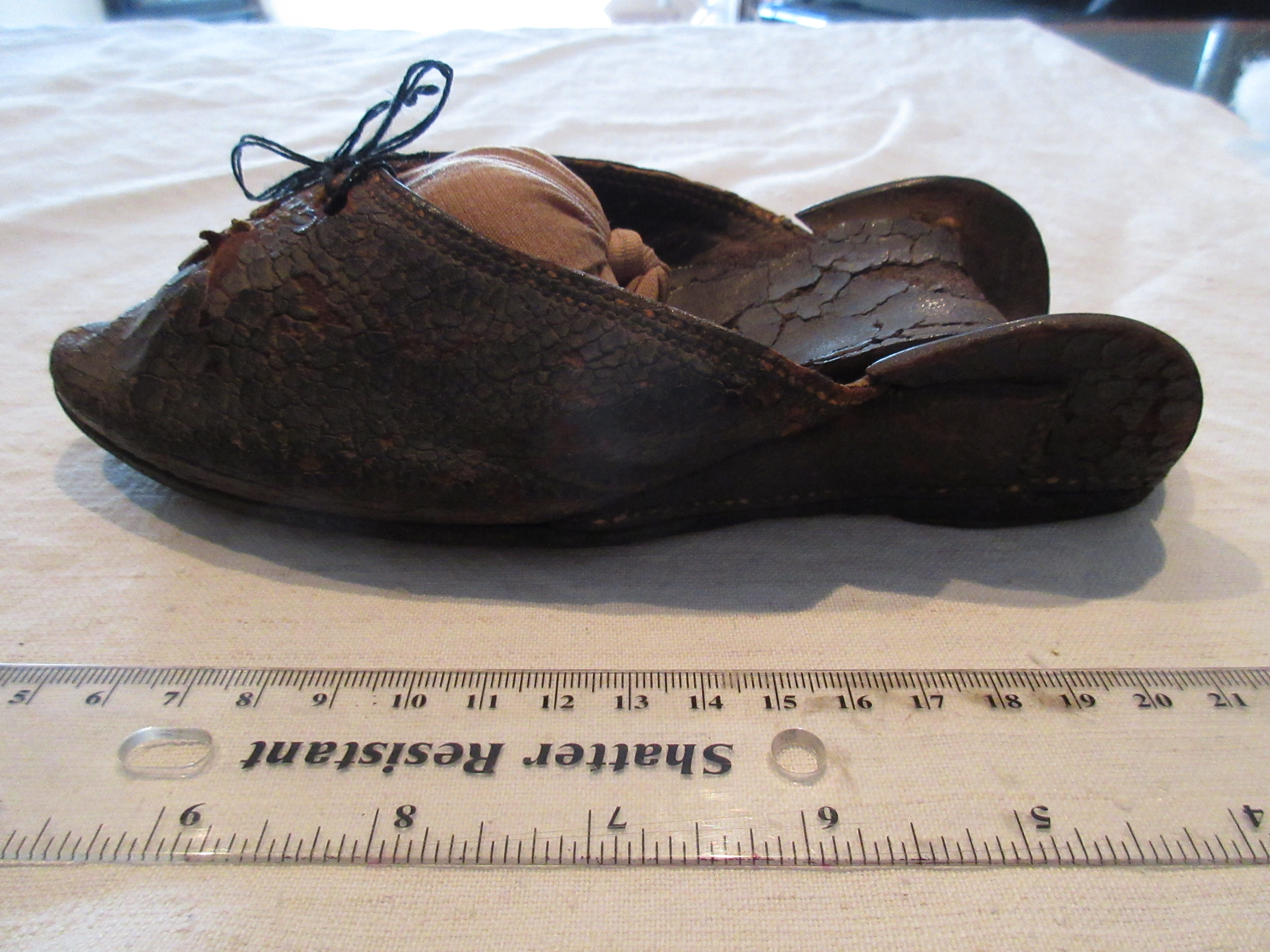
This single clog, one of a pair at one time of course, I would say was more of a working-class middling sort's possession. Maybe they were owned and worn by a merchant....someone who wanted to protect their shoes indoors but needed something a bit more robust than a cloth upper. AND...speaking of uppers...we get to the reason I had to add this amazing creature to the collection in the first place.  The upper is closed! Look back up at the Powerhouse Museum examples, and the Met...all of them I have ever seen are open-toed with just a strap to tie up over the vamp of the shoe. I have never, ever seen a fully closed upper on a clog, so this just thrills me to no end. Above here you can appreciate the deep heal seat to accommodate the timber heels of the period.


The leather is very worn, but the expert hand stitching is still nice and tight and can be fully appreciated. The single eyelet holes for ties are stamped from the leather and left unfinished. 
Construction of the heel is the same on these as is typically seen on the cloth examples. One may be so inclined to wonder if the timber heels were so very fragile they needed support from underneath in order to get the most wear out of them???

From the view of the sole one can see these did get much wear. There is but a tiny single layer stack on the heal, other than that they are flat on the bottom. The wear shows they were tied on quite tight, as there are no signs from the wear on the sole that these were shuffled along as a person walked in them. The heels did not drag off from flopping down off of the shoe when the foot was picked up. 

Have you ever seen a solid or closed upper clog? If so, send me the link, please!

Wednesday, July 14, 2021

A Few Thoughts on Washing...

 First Quarter 19th c Child's Gown & Cap

 I often get questions on how to wash items, and what I use to wash them with. I cant offer a blanket statement that I use product X to wash with because honestly, every article of early clothing is its own unique situation. Every stain is unique...is it organic? Is it grass? Is it clay? Is it blood? Then one must take into consideration the fibers of the material~ are they natural or synthetic? Cotton? Linen? Silk? You get the idea. But I can offer my recommendation on how to remove overall dinginess from cotton or linen. 

 First I must determine if the textile is strong enough to withstand a wet wash. Textile fibers are very fragile when wet. Just the weight of the water in the fiber can be enough to tear sheer textiles like cotton mull. Does the garment or textile have any metal bits like fasteners or buttons? I never wet wash any item with metal parts. Another thing to consider is trims...for example, early sequins around the turn of the 20th century were made from celluloid and literally dissolve in water.  Does the textile have any colour to it? Be it printed or woven, not all colours are colour fast, so one must check in an inconspicuous place to see if the colours bleed. If I am preparing for a spot check, then I first ask myself what is the purpose of the washing? I usually choose not to wash 95% of the time. Stains are part of the history of a piece. They help to tell the story of how a piece of clothing was worn. Stains can talk! Occasionally I have a piece that could benefit greatly from a freshening up, such as this set here of early Empire period gown and corded cap.  The above picture is before washing. The gown is overall just quite dingy, with a real yellow~brown cast. Only on close inspection could one realize it was made of a woven pink and brown stripe cotton. 
 Because fibers are so fragile when wet, I check for any rips or tears in the piece. If they are able to be stabilized before washing, I will do so.  The rouleaux trim at the base of the crown on the cap was partially detached, as shown above. 
The trim was carefully stitched back in place through the original stitch holes before being washed.

My soap of choice for washing is Orvus Paste. It is a fantastic ionic neutral ph cleaner that is very gentle on textiles. (Its also good for washing cattle and horses...so you may get lucky and find it at your feed store.) It is the best most gentle cleaner on the market~ absolutely conservation grade and can be found on Amazon.
Whenever you wash an early textile, it needs to remain flat so to remain fully supported and to keep it from tangling into knots(which will happen if you put things into a BUCKET).  Don't get me started on the horrors of washing things in a bucket....just ...don't...do..it.
I prefer to dip my clean hand in my Orvus and hold the paste in the stream of water as I fill the basin. For this gown, its so small, I only filled the basin with about 2" of water. Really swish your hand around until all of the Orvus is dispersed in the water.

It is only then that the textiles are carefully placed FLAT into the bath. I gently press down with a flat hand to coax out any air bubbles. There is NO AGGITATION. I put the lid on and let this set for at least 24 hours. 

The picture above is after the first 24-hour soak. The water is now a very dingy yellow...hmmmm the same dingy colour of the gown. To remove, I carefully coax the gown up into a little ball and lift it out of the water, fully supporting the weight of it. Did the same for the little bonnet.  I ran a second Orvus bath and let the two pieces soak again for another 24 hours. 

The Orvus baths are continued until there is no more dirt releasing from the fibers. Then the same thing is repeated but with no soap, just clean water to rinse. This is the third clean water soak. When the water remains clear one can be sure all of the detergents have been rinsed away.
The gown and cap are then carefully taken out of the water, again, by scooping up into a little ball and removing from the water all at once. They are then laid out flat on a towel to air dry. The last thing you want to do is hang up a wet garment to dry if it is fragile! 

This is a photo of the gown and cap after fully dried. It actually has a bit of a pink cast to it. Gone is the dingy yellow overcast. You will see that the stains are still there. If I wanted to remove they could be treated with enzyme detergents, but my goal is not to have a new-looking garment. 

 The goal of washing for me, is to remove the distraction that overall grubbiness presents when mounting. I want people to be able to see the garment for what it was. I want the stains to be there to tell their story.

But to not be so garrish that they attract attention over the construction of the piece, or the fabric, or the overall design. Most of these stains were probably from storage, being laid directly on wood or acidic paper linings in a chest or trunk. 
The few tiny stitches made to reattach the trim are microscopically noticeable, but more importantly, the integrity of the trim on the cap has been restored.

I did add a new drawstring to the center casing. The original cord drawstrings are present at neck and sleeves. She's pretty cute for 200 years old don't you think?

Monday, July 05, 2021

A Summer Weight Suit

  To Celebrate Summer, 1825-40 Style!

Happy July! I hope all of my US readers had a happy & safe holiday this past weekend. I am now home from a up to see my parents in Washington. It has been over 2 years since I had seen them due to blasted covid! It was HOT.  Pip cooked an egg on the sidewalk on a 105+ degree day...and yes, I have the video to prove, it really does work!  I had planned to put up this year's ornament kit for sale when I got back home, but as usual, I am a little behind. I took work with me on my trip, but just couldn't wrap my brain around it so here I am, behind as always. Hopefully, I'll get it done and up later this week! 

In the meantime, I wanted to share a peek at this stunning little buys suit. I have a wide date on it from 1825-40 as it is so hard to date more everyday wear for boys that dont have fashionable cuts to help date them. The high armscyes, curved back seam, turnback pointed cuffs and faux waistcoat can all be found in garments in that time period window. Straps on petticoats and trousers were very common in 1820-30 periods, and some even crept their way into the 1840s. 

One thing that I love about this particular suit is its condition. It was not worn once on some special occasion and put away. It was a daily use garment and it shows magnificently by the wear and repairs. The above view of the trousers is the backside of them. Note the coarse printed insertions center back...this is not an alteration. The waistband, this back section that would never be seen when worn with the jacket, and the lining of the jacket is all original construction. The plaid fabric has been pieced together from several tiny pieces~ most likey leftover scraps from Mom or Dad's clothing. The trousers are open from the crotch to the waistband in the back, as shown. The cut of the seat is full to allow ample room for the bum when sitting.


Here is a closer view of the piecing in the back. No evidence of back closure, these would have been pinned closed. 


The linen straps have been lengthened. In the above photo at about the 3:15 pm position, you can see the seam of their original length.


The fabric is a summer weight, very light and thin. There are several worn holes to both the front and back of the trousers. Some are mended, some not. 


I love the woven design of the fabric...a woven plaid not printed, but with random streaks of blue that breaks up the pattern and makes it look very organic. 


The tunic or jacket is wonderful. The body and arms are fully lined. No lining to the skirting. Lovely little turn-down collar. Piped seams. All original buttons have been removed. Construction includes an inner faux waistcoat~ meaning that the front closure is basically a double flap so that it looks like the little guy is wearing a matching inner waistcoat. The outer flaps fold back to form a fashionable lapel.


Remenants of original buttons remain on the lining.


The back view~ from shoulder to trouser hem this set is a mere 28" measure. Cute!


Worn in the usual places, bum, knees, elbows....  

Here is a tip when trying to decypher original garments and wear, from 'fakes' (garments made to deceive)...

Elbow wear is nearly never at the actual 'elbow' but below it. When wearing a long sleeve jacket we tend to jet the arms out forward before we bend them, say to rest the elbows on a table. This, along with bending of the arm, hikes the sleeve up the arm...wearing the fabric in an area down closer to the wrist.