Thursday, April 16, 2020

I feel like I'm in the Twilight Zone....

Hollie Point Baby Bib/Apron 1130.2020.22
  Wow, I really am in the Twilight Zone. I thought I made this blogpost yesterday....and this morning, I go to check my email, and here it is.....sitting here on the screen waiting for me.  Josh is working from home, Pip is schooling from home....not only do I not know what the heck day of the week it is...I cant even tell what hour of the day it is.  Last week seems like 2 seconds ago....and yet again, like a year ago.
So next out of the basket was a bit of a ball of fluff that when opened ended up being two wonderful baby bibs~ the first, this one with a Hollie Point lace insertion down the front

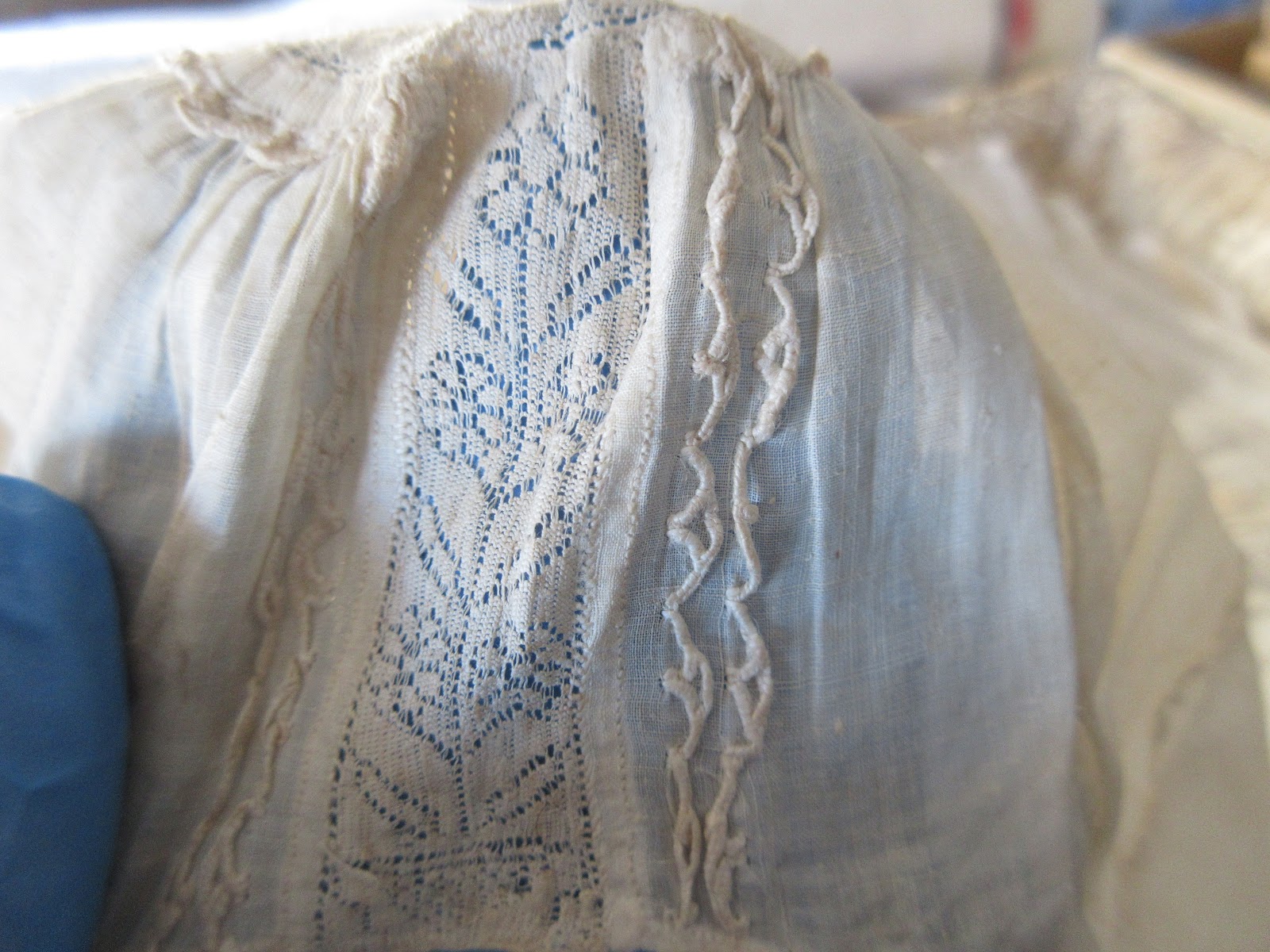
The construction is simple, two shaped bands of linen whipped to each side of a band of Hollie Point lace, over which 3 rows of of lace have been stitched on, with the entire thing edged in same lace.

The Hollie Point band has the typical eyelet loop edges, and is the same potted flower pattern as the rest of the pieces in the basket.

Here you can see a little of the back, how the lace is loosely stitched on, and also the attachment of the linen tape ties at the neck.  Note the placement of the ties, allowing for the width of the bib to fall over the baby's shoulders when worn. 
So...is it a bib.....or an apron?  I know I will get this question, so will try and explain my termage here~
Early baby things are hard to identify, period.  So many were handed down, reused...made for new mothers by family members that remembered things their own parents used, or that they used when having children...so one cannot use a flat 'fashionable cut ' sort for dating.  I look at provenance if available,  the materials it is made from...was the piece together with a group of like items?
This piece was together with a grouping of early 18th c items, has the same lace as many in the basket, and since the basket is centered around Christening items, I am more inclined to identify it as a 'bib'.  But, truth be told, if I would have found this alone by itself, I most certainly would call it an 'apron', as it is nearly identical in cut to the decorative aprons that are pin'd on top of swaddling bands in this era. Could it actually be an apron and just the only survivor of yet more matching pieces that were indeed a swaddling set....sure it could. But I'm in no situation to speculate on that...heck I don't even know what day it is.

Saturday, April 11, 2020

THANKYOU for NOT washing!

Christening Sash 1129.2020.21
 Next out of the basket  was three folded/rolled strips of wide silk ribbons. I could tell immediately what  one of them was, because it had the same silk fringe trim stitched to the end, that matched with others in the basket.  Unrolling it I got super excited because it was it's full length, and was what we would refer to as a sash for a gown.  So many of these things would get reused for other purposes in the years after the Christening set was no longer needed.  We have several 18th c Christening gowns here in the collection, but none have their original sash with them.

There were two other lengths of ribbon along with, one nearly identical in weight and width, seen far right in the picture above,  but just a few inches long with torn ends....and then another length of a leaf brocade seen on the left.  What is super exciting about the actual sash....is those folds there~ do you see them?


 Having these folds still remaining on the sash, tells me exactly how it was originally worn. The exact width of the folded pleats gives the measure of the width of the sash as worn,


and exactly how much of the sash was pleated to go round the baby's body, as there is clearly an end point to the pleats.  They were not stitched, just folded and pressed. The narrow part would go round baby, tied to the side or back, with the wide fringed ends gracefully cascading down from the bow. 
It may seem silly, but its times like this, when one is truly grateful that the item was never washed~ washing removes the clues to how something was placed on the body. Even lines/areas of staining can provide essential clues as to how an object was originally worn....especially with baby things!  

Wednesday, April 08, 2020

Next...

Bonnet 1135.2020.27


Next out of the basket is the last of the bonnets~ I think this one early 19thc.  Not the finest sprig'd muslin, but its still a nice example. There is a 'V' insertion of lace over the crown, and all those rows of cording to the front.  This view shows them let out, and you will see in the next picture, the other side with them slightly gathered.  


 You can see, just how much fabric can be drawn up in a small space. At the top of the photo, you can also see the ends of the center front drawstring ties.  If one did not have the money or time to make a slew of bonnets for a growing child, one such as this would suffice for some while. The side and front drawstring could be gathered fully and make quite a small size head covering~ as the child grew, the strings were let out. Some also have another set of ties at center back, to gather along the nape of the neck. 


A double row of lace make a simple yet charming frill around  the child's face. 


   There are two cords for every channel..making for a lot of threads to keep track of! The rows were usually tied together to keep their size~ as in, the two left most pairs tied together, the 2 rightmost tied together(note there is only a single cord adjacent to the lace)...then, just wrapped round the fingers into a neat little bundle and tucked up inside the cap when worn.


Sunday, April 05, 2020

Next out of the Basket....

 Bonnet 1133.2020.25

I love this little bonnet~ my favorite of all the bonnets in the basket, even over the Hollie Point one.  The construction is nothing out of the ordinary~its the usual classic shape baby bonnet with round crown and little lace frill round the front and neck edges 

  What melts my heart about this bonnet, is the amount of hand work that has been put into it. Each stitch, placed with love and intent. The hours that went into making the lace around the edge...most likely purchased by the maker and not made by them....but, as I was not there, I could not say for sure.

 I love love love the embroidery on this sleeper. I call these sleepers...because from a ways back, one thinks, ah, just the usual utilitarian bonnet. But the closer one looks, the more marvels they behold. Chain stitch vines and fancy scrolling stripes, alternating with drawn thread work and those little eyelets~ sooo precious!

  With magnification one cannot appreciate the minute scale the embroidery is executed in, until there is something in the photo for scale.

  I would love to have eyes good enough to be able to sew this small without my magnifiers on....and as I am getting older, my magnifiers are not even working any more.  Do enlarge the pictures, I just had to leave them big so ya'll can see the stitches!

  Rows of minute drawn thread stitches between chain stitch scallops....from my years of studying early fashion, these patterns are hinting to me this is a very late 18th c to early 19th c bonnet. Baby things are very hard to date by the thing itself, unless it has some unique construction, or say, is made from a woven silk or printed material~ then that can be used to help date. Alot of times, if the item is in a set or grouping that has remained original, we will use clues from other items in the group to help date. There is one wonderful piece still to come out of the basket, that helps me to date this little bonnet to perhaps very early 19th c....
but until then...

The delicate lace crown~

Tuesday, March 31, 2020

Weekend Progress

Yes, I am still open for Business
 WE have been on a stay at home order here in Colorado for some time now, but I am still allowed out to the grocery, and post, bank, ect, so yes, I am still working, and yes, I am still open for business & shipping orders!  I have limited myself to only one trip to the post per week tho, so please do have patience if you do not see a tracking number right away for your order.  We are all well here, I have been 'self isolating' I guess I can say, since I got back from Williamsburg the last of Feb. I usually only venture into town to go to the post or the grocery(once every 2 weeks only!) anyway, so nothing new here for me.  I am still making dolls, taking custom orders, making figures and supplying threads/linen~ if Access Commodities has it in stock, I can get it for you if you are in a thread emergency~

  I had a large order of figures that I got finished up on Saturday morning (the last that went out in the post yesterday, so if you are expecting one, check your email for tracking info!) and so decided to spend the remaining Saturday and all day Sunday painting another side on the travel case. Was really excited to get the lion side finished, so that I could finally mount the carrying handles, a wonderful set of 17th c reproductions I had made in England.

 
  I trimmed the bolts down on the inside so they don't interfere with the casket.  Before I get nasty grams about the mask hanging there....I've had it for years and reuse it over and over~ no medical person would want it!

Super pleased, just the back and top now to paint, but those will wait until the next batch of boxes I have to make are finished.  
Patience. Respect. Compassion. Gratitude. Love. 
XOXOX

Friday, March 27, 2020

Hollie Point Lace

18th c Baby Bonnet 1134.2020.26

    Next out of the basket was this cunning little baby cap or bonnet~ hand stitched from a super fine lawn, with insertions of Hollie Point lace. 

  Here it is how it looked next out of the basket~ my hand was drawn to it immediately when I spied the Hollie Point.  After so many years of looking thru attics and old dusty boxes of crumpled up textiles, one gets an eye for spotting things for what they are, not so much how they look at that particular time.  If you see Hollie Point lace on an item of clothing, it's usually going to be a baby item, and it's usually going to be 18th c.

 So just what is Hollie Point lace?   It is an early 18th c origination of  needle made lace. The stitch is somewhat similar to the button hole stitch seen in later needle lace, but this lace's design comes from the holes left between stitches, rather from the stitches themselves.  In this picture above, you can see my thumb there for reference~ always so very fine, just miniscule little stitches. This type of lace was very labor intensive, took many hours to execute a small amount, which is why it is usually reserved for smaller items. Having a blue glove on helps to see the pattern of the lace more clearly. Aside the insertion of lace, there is tiny lines of drawn thread work, and then two rows of scalloped buttonholed loops that stand erect from the surface.
All of the Hollie Point lace on the various items in the basket share this same flower basket pattern.
  The cap back repeats the large flower, with an addition of  a crown flanked by sets of diamonds.  An interesting note on dating baby caps with Hollie Point lace~ if there is a strip up from the nape of the neck, and then this round at the crown, that would be called a 'keyhole' opening, and those usually date to first half 18thc.  The second half 18th c saw the addition of Hollie Point insertion from the crown to the front, which this one does have, dating it to the second half 18th c.
 
I want to show the superior and super fine stitching on this bonnet~ even with my finger here for comparison, it is hard to realize the actual scale of the stitching. Counting in several different areas on the bonnet, with my loupe for magnification, there is at minimum , 39 stitches per inch. 
Please do enlarge the photos to appreciate the details!

Monday, March 23, 2020

Happy Monday Ya'll

  Christening Pin Cushion 1137.2020.29
  Many of us today, take for granted the humble straight pin, and have no concept of what an important, indispensable tool this was in the 18th c and before. Before there were zippers and velcro...buttons and hook/eye closures....there were pins. Simple, straight pins made from wire, that were used to hold ones clothing together. 
Not just outerwear, or the elaborate ruffs worn by Queen Elizabeth that come to mind when most folks think of early usage of straight pins (each one of those glorious pleats was held to its neighbor with a pin)...but pins held everything together, on adults, all the way down to babies. Just wrap your head around a newborn having its pilch,(diaper), pind closed....along with the shirt, the gown, the bonnets..the forehead cloths...if swaddled all the wrappings and aprons...all held tightly together with pins. One would need a sea of pins to be dressed properly~ so not only were pins vital to dressing, they were quite valuable. Pins were often listed alongside jewelry in estate inventories and wills.

  This cushion is exciting because it remains with its original set~ it is made from the same cream silk satin as the gown, bearing cloth and basket, and is trimmed with the same silk fringed fly trim. From feel, I cant say exactly what this cushion is stuffed with. It feels and sounds like a mixture of maybe straw and hair...possibly wool, which would make sense as the lanolin in the wool helps to lubricate the pins and keep them from rusting.

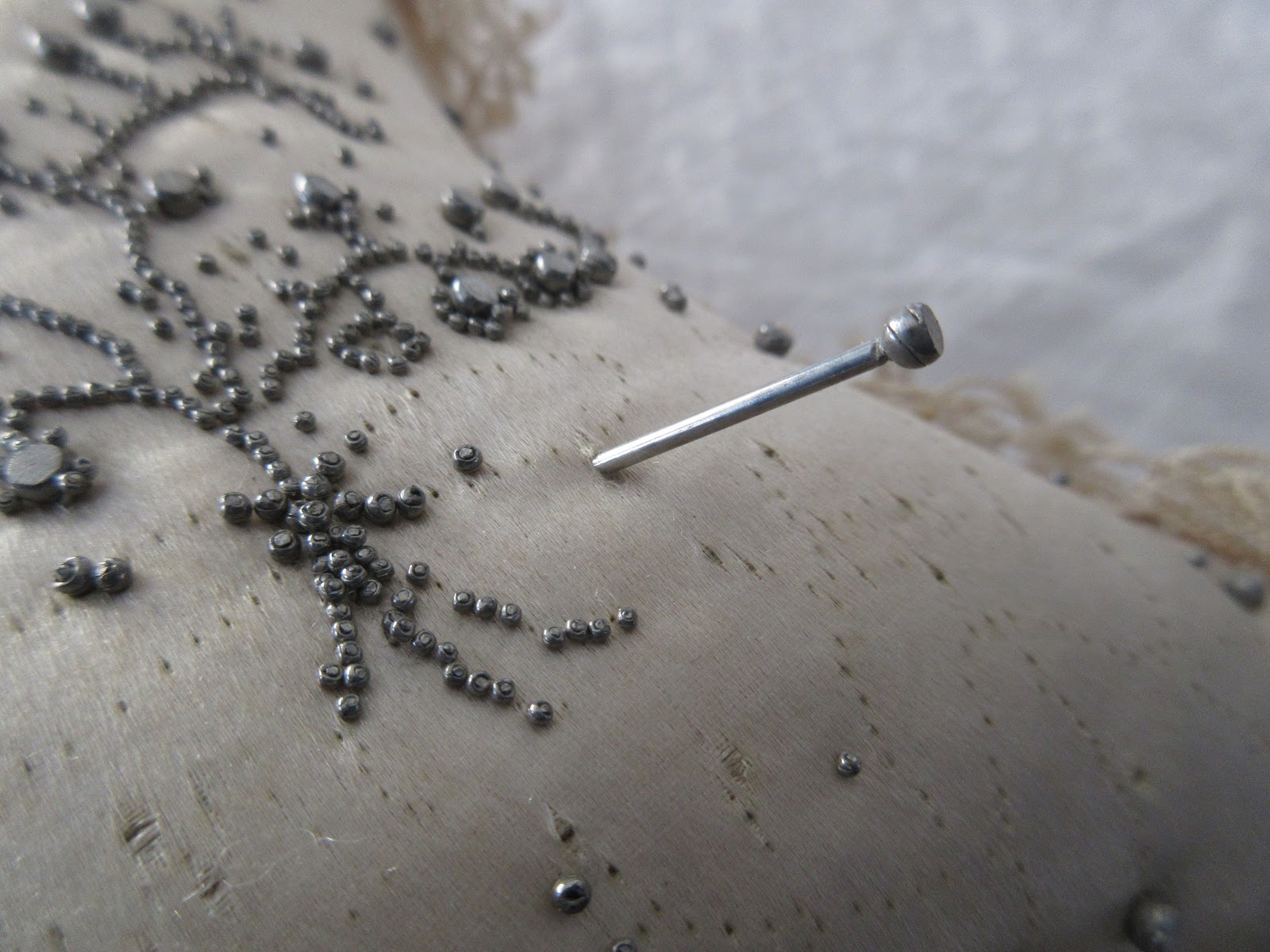
 It was common to make a pretty design with the pins on the cushion~ many toward the later 18th c and early 19th c had sayings worked with the pins~ I'm sure most everyone has heard the saying 'Welcome Little Stranger'.  Some had initials, and even dates on the cushions.  This cushion's design is a bouquet of flowers with a zig zag vine border round the outside edge. Not too many of the pins have been removed and placed back hap hazard, so the design still remains true to its original placement. If  enlarged, three different sizes of pins can be observed.  Tiny fine pins make up the bulk of the flower stems, a medium size pin the bow and flowers, and absolutely huge pins, more akin to nails in my opinion...the center of the flowers. 

   Before mechanization during the Industrial Revolution, pins, including these shown, were all made by hand. The process of hand making pins was very labour intensive, and involved several different folks, each doing their own specialized jobs, with up to 18 separate steps being needed to make a single pin.
The pin itself was made from a length of wire, with the head made from another piece of wire of similar diameter to the rest of the pin. It was coiled around the body of the pin and moved up in to place at the top of the pin, and referred to as a 'wound head pin'.  It was hard to produce pins this way with all the heads being the same size, and as well, the bit of wire at the top could snag on the clothing. This led to advances where the head of the pin was stamped into a flat or ball shape from the same piece of wire from the body of the pin(early 19thc). During the 18th c, large pin manufacturer's laborers could produce about 5,000 pins per day. 
Do enlarge the photo above and study the heads of the pins~ the amount of slight variation on the heads is beautiful.  Little wire tips can be seen sticking up on the smaller pins. There is no denying the look of a wound head pin~ the wire can easily be seen wrapping around to make the head. The larger pins are interesting. Looking from the side, seams in the head can be seen, and looking close at the tops, they have been ground down flat and the center of the pins can be seen. 

  The large pins are more of what I would expect to find in adult clothing use, but many are missing from the cushion so were used just as much as the smaller pins. These things are the most robust straight pins I have ever seen....I don't even think one could get a modern straight pin in this heavy a size today.

The largest size pin, alongside the finest pin in the cushion. Glory be to the early pin makers is all I can say! Even these little bits....are each such works of art.