Tuesday, March 26, 2013

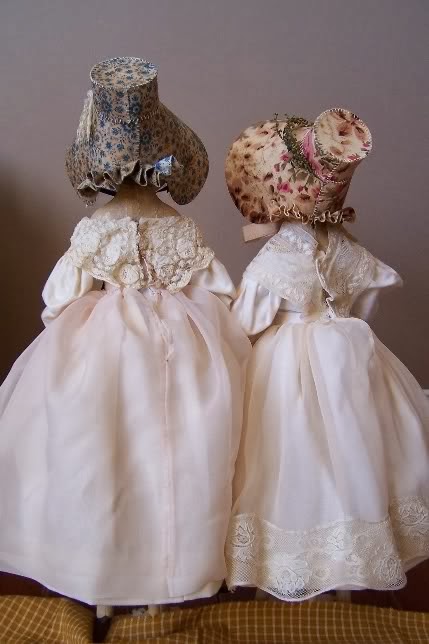
Mabel, a Special One of a Kind Queen Anne on eBay


If you are a follower or collector of my dolls, you will know I have sold online at the TDIPT Mercantile for many years now. If you havent heard, the TDIPT Mercantile is closing its doors in April.  Behind this doll are many years of fond memories of the Mercantile~ all the dollys I have made and sold there (over 300!), and all of the wonderful people I have met.  Some of you may remember that my first dollys were cloth Queen Annes.  I made three special primitive Queen Anne sisters~Mary, Mabel, and Moira, to honor those first precious ones.  Mary was my final dolly offering this past month on the Mercantile, which left Moira and Mabel. It has been a very difficult decision trying to decide which one to keep for me~ honestly I wanted to keep them both!  I chose, or actually, Moira really wanted to stay here with me, so I am so pleased to offer Mabel on eBay this week. She is so very special~ named for my Aunt Mabel~ if you like you can see more of here here on my eBay auctions : 

It has been my great Honor &  Pleasure to serve you on the Mercantile, I am so sad to see it close. But with every closing of a door, a new window opens, and I also have the wonderful & exciting pleasure to announce that I will be joining  the marvelous artists at  the PFATT Marketplace in April, so do watch my blog here for more news and the link to my page there coming soon!

Tuesday, March 19, 2013

A c1730 Embroidered Silk Apron


  At the time this apron was made, they were a popular project of instruction for the fashionable young ladies of society. They showed not only wealth in the materials used for their embroidery, but also the skill of the schoolgirls who made them.  Early in 18th C Boston, Mary Turfrey boarded girls in her home, and taught them how to expertly wield their needles~ in reading the Diary of William Bentley, a young girl worked a marvelous apron under Mary's tutelage ~

   "3 feet by 2, edged with points, & tufts upon them, eight springs with balls of gold within the edging, flower pots and flowers at the lower corners of gold, between a pot with flowers of cruel [crewel]. Two birds between of gold bodies and one in the center of the same. Above are worked two false pocket holes, forming an apron."

  My apron is near exact in size, and looking closely in the photos above,  are two false pocket holes, the slits never having been made or finished.

   This embroidered silk apron resides at the MFA in Boston, accession number 53.243.  It has a quite similar scalloped edging with near identical embroidery design to the edge. Also note how the edge pattern stops well before the top of the apron~ a detail also just like my example.

   The majority of these embroidered aprons I have seen, have been worked on a plain silk taffeta ground~ a simple backdrop to not detract from the focal point~ the embroidery. The hem edge is simply turned and finished after the embroidery finished.  

  Here is a closeup of one of the unfinished false pockets. At the top shadows of the original gathers can be seen, but no prick marks. Instead of being carefully unpicked from its original soft 'U' shape waistband, it was cut, just underneath of it. So many of these aprons have survived without their waistbands, but yet not remade into anything else,  one cannot help but ponder if it was at some point fashionable to display them framed
  This outstanding apron was just sold last week at Skinner in Boston, having previously been part of the MMA's collection.  Its false pockets have been slit with edges finished~ do click on the photo to make it larger
Now tarnished to a dull black, many of the flowers and leaves are have been worked in a variety of real silver threads~ this bud using a rococo , a sort of bumpy thread.  These threads were very, very costly in their day, and used most sparingly. To save thread, they were worked only on the top of the fabric, being couched down with a contrasting silk thread, which, in itself also added to the design
 This back view shows how not a single bit of the metal threads were taken thru to the back. Actually, I really enjoy the pattern the couching threads have made~ the work so neat and fine, its just as much a treat to view the back as the front

   Different weights of silk threads, different twists of silk threads, as well as the use of metals and knotting, make this apron very textural~ not at all plain. I can see these as being a sort of 'practical' sampler of sorts~ not just something to hang on a wall, but something of ones own work to actually wear around and be so proud of.
   Expertly executed long and short stitch

 For your further reading~ "Women's Work, Embroidery in Colonial Boston" by Pamela Parmal  will afford you many hours of  enjoyment

Thursday, March 07, 2013

Fate, Hope & Charity~ 
exhibition at the Foundling Museum, London 
  25 Jan - 19 May, 2013


  Absolutely not to be missed if you are in or anywhere near London at the above slotted time.  Many of my readers are familiar with the 'Threads of Feeling' exhibit which showcased just a sampling of the thousands of textile bits kept within the records of each child who was dropped of at the Foundling Museum in London.  This year showcases is a new exhibit that focuses on the tokens left with the children~ some will absolutely break your heart
   As with last years exhibit, Faith, Hope & Charity is accompanied by a wonderful book ~ not a catalogue of endless photos of the tokens, it is an absolutely wonderful collection of essays and stories of a selected few~ you will not be disappointed  and I couldn't recommend purchasing one more~ you can do so here~

http://www.paul-holberton.net/fate-hope-charity,product,view,259,,,.html
   
 You will be supporting the Museum in doing so, as well as showing how important these little publications are in making a small local exhibit offering into a worldwide educational opportunity  Their information and photos keep the one time exhibit 'running' for years and years after they have ended.  Feel free, as I have done, to email Paul Holberton Publishers and thank them for agreeing to publish this book!

  The middle photo is but one heart wrenching token in the collection~ can you read the cypher?  It reads, " I want relief , and initials of the inscriber, GB Jan 16, 1759 "

Sunday, March 03, 2013

A Regency Jane Austen Era Ladye on eBay


   This precious, absolutely precious girl is offered on eBay this week! Dressed from one of my most favorite eras, the first quarter 19thc, c1813 to be exact
  ' I ' sculpted her to be a Queen Anne, but as you can see, like so many of my dollys do, she told me who she wanted to be!  xoxoxo rachael


Sunday, February 17, 2013

Whatever The Desire~ My Joy is to Make


  I love making dolls. I would need a hundred lifetimes to make all of them that keep my company in my mind. As much as I like making the ones in my mind, I enjoy that much and even moreso, the ones I make from the dreams of others.  I get emails often asking if I make special order dolls, custom one of a kinds, and the answer is yes! There is no greater challenge, than bringing to life an image and spirit borne of someone else's mind.  As well, there is no greater joy than seeing their love and satisfaction in their finished doll.

 .  Ordering a custom made doll from me is quite easy. Normal time from start to finish is 95% of the time, 30 days or LESS, for the most common 16" and under dolls.  The first step is of coarse to email me and let me know what you are thinking of~ size, era, price range you have in mind~ enough general info for me to give you an accurate price quote. I do not start a custom sculpt until payment in full has been received. Some will pay all in one payment, while others have placed their dolly on layaway~ when their final payment is made, I will then start the sculpt.

  The owner can choose painted or glass eyes, what color of eyes, face type, any special materials~ sometimes a special fabric or lace of their own is sent on to me to incorporate into the design.. I have even  made wigs from a loved ones own hair.
  Dress is discussed while the sculpt dries naturally, which can take from 1-2 weeks to closer to a month for larger dolls, depending on the current ambient humidity levels. When the sculpt is finished, and we have decided on a name, paint and glaze are applied and dolly is born.  Costume can be as simple or elaborate as one specifies, and once dolly is finished, I will invoice for the shipping & send dolly on to her new home.  The possibilities are endless, so if you have wanted a specific doll and just haven't been able to find her yet, feel free to drop me a line at rlkinnison@yahoo.com


Thursday, February 14, 2013

 Stop by and say hello to the girls!  Hope you all had a wonderful Happy Valentine's Daye   xoxox  rachael

Saturday, February 09, 2013

Lady's 1810-1820 Nankeen Walking Boots

  Nankeen~ a plain weave cotton cloth sold originally at Nankin China made with a slightly yellow variety of natural colored cotton.  the 1807 phamplet 'Prices Current at Canton' states " The yellow nankeen is made from the cotton in its natural state of colour, never having been dyed, and the colour improoves and grows darker and more beautiful by age".   The above 1818 fashion plate shows a gentleman wearing his trousers of nankeen
 
Today I wanted to share this wonderful pair of c1810-20 Lady's Nankeen Walking boots with you~ of special interest of you are a Jane Austen fan, as she wrote often about the difficulty of finding good sturdy boots for walking~ indeed, in an era that shoes for the lady were quite delicate, in both construction and materials, the new walking boots were all the rage for a Ladye of Fashion


   This 1812 fashion plate shows a young Miss out and about in her green walking boots. One cannot see much detail other than they are definitely above ankle height, and front lacing. The soles are very flat, nearly no heel, and there is a bit of fringing at the tops for decoration.


Upon first glance, if you were unfamiliar with the era, you may mistake these for being canvas swimming shoes so popular in the 1890s...so lets take a closer look and see what we have going on, that really makes these boots special


 Looking at the inside, there is an illegible inscription in the right boot made on the linen lining. Below the linen footbed can be seen. To the left edge, the silk binding can be seen, along with the handmade eyelet holes for the laces. Note how instead of beginning anew and knotting the thread at each eyelet hole, the holes have all been stitched in a row, with the trail of back stitching traveling from one to the next. This is carefully done, thru the linen lining only, not thru to the outer fabric

 Love love LOVE the tongues! Tall and narrow, lined in linen and tipped with a silk binding at the top. The tongue reaches to about 1/2" below the top of the boot

  Pretty silk ribbon bows trim the vamps, very popular for shoe trimming in the first quarter 19thc. They give a quite delicate and feminine look to an otherwise plain everyday boot

 They also help hide the two rows of stitching that attaches the tongues to the inside of the vamp.

 I thought this little detail very interesting, the addition of skye blue kid leather points to the center back seams, obviously to reinforce where a person would hold the back of the boot and pull it up the leg. These are exactly the same on both boots

I can remember Emma, while walking along in  Jane Austen's book of the same,  using her broken lace as an excuse to tarry behind~ The Lady who wore these did not let such a thing get in her way, she simply knotted the broken lace together at the point of the break and kept on.  Both retain their original lace by the way, this one the entire length with long metal tip, the right boot with but a fragment.  I have read in more than one place that it was the fashion to have the lace match the color of the shoe/boot, and in this case, it certainly does
  Plain silk binds the seams and openings~ these are tall boots, not at all 'half boots', but full Lady's Boots standing 8" tall. I think I can count on one hand the full boots of the Regency Era that I have seen in the flesh~ one more commonly sees the much lower half boots that came just to the height of one's ankle bone

 10" from heel to toe, its nice to see proof not all of our ancestors were Lilliputians!

 The back of the boots are cut to follow the gracious curve of the back of the calf & heel, with the CB point being slightly taller than the front

 Very low heel, a single thickness stitched on over the back sole
 Quite a bit of spring in the toes (upturn)


 Made straight last, (no right or left swing of the soles). These have even wear with a bit of organic material still retained in the nooks and cranys, most definitely used for walking, but on a well kept path and certainly not out in any foul weather.  One advantage of the Nankeen in shoes and boots was that it could be easily washed. These dont show me any reason to think they were ever washed at any point in their lives

  Heels worn pretty even, a smidge of more heavy wear to the outer heel, but not much. Our Lady was a graceful walker~

This 1813 fashion plate is a good example of how these would have looked in use.  Colors were very, very popular in both shoes and boots for much of the early 19th century, but a good neutral color could be worn with several outfits, and were much more sensible for the average Lady to have in her wardrobe.