Sunday, May 31, 2009

Diamond K Folk Art 'Dollye Couture'....


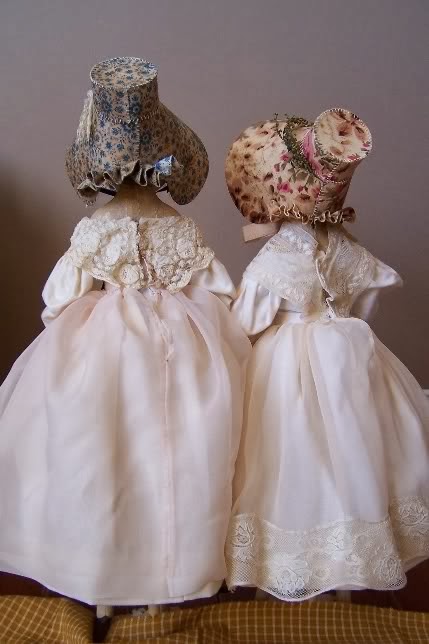
I love making dollys, but I don't know which I like best, making the doll, or her clothes! I revel in the weensiest little details, and so many times they get lost in the big picture. I have several types of dollys that I make, but my 'Grande Dames' are the most special of them all. These dollys are a bit larger, have their own trunk or box, and come with removable wardrobes...some even with interchangeable wigs. Most all the clothing on my Grande Dames are reproductions of early garments, completely hand stitched with the utmost skill and care.


This photo shows the inside of a reproduction pannier hoop~ you can see the ties inside it that shape the wooden cane hoops, just like the original one. This one is property of Ladye Georgianna Juniper....
I would describe my Grande Dames as my 'dollye couture', as they are the best of the best that I make. Every now and then, on very special occasions, these dollys and their owners could be invited to take part in special soiree's and events....dolly's do love to party....and who could resist a chance to have new clothes made!

This is the quilt pattern I drafted for Ladye G's quilted silk petticoat. The design as you see it is exactly taken from a 3rd quarter 18th century quilted petticoat, but because of the scale I am working, I did not quilt the zig zag in the center of the large swags.

It took me 42 hours of hand quilting to quilt this coat~ I used a precious baby pink silk taffy over a flannel lining for a smidge of loft


Spending so many hours on her coat, I didn't want to cover it all over with a dress or robe, so Ladye G is getting a jacket to match~ a reproduction c1720-40. This is the first sleeve being pinned in.


I love to work with silk, but it does ravel, so all the seam allowances that are showing get overcast.

This is her basic jacket's bodice completed. The front flaps are faced, and awaiting to be joined with the skirting
I fit the pleats to her waist before fitting them to the jacket, to be sure they layed correctly


Here is the back view of her new jacket. The hem of the skirting will have some wonderful trim, and the front will be laced over a stomacher....but that is left for us tomorrow.....

Saturday, May 30, 2009

Hazards of Summer never change...


It is officially summer vacation here, the children out of school 2 weeks late due to the construction on their new school slowing things up a bit. They are all so excited, and we will be setting up the big pool this week, so , like every summer, I was giving Josh the lecture of what he can, and cannot do. As his eyes started to glaze over, a little book I have here at the Museum came to my mind. Seems things never change, and it is reassuring in a way, that the cycles of life and our habits stay basically the same over time. Hundreds of years could pass between generations, and yet, at the same time each summer, we both share common occurrences and rituals.

The little book I have, shown above, is a wondrous little children's book printed in 1834. Referred to as 'Chap books', they were published specifically for children. This is at a time when childhood as we all know it, was coming into itself~ no longer small adults, children were allowed to play and grow, physically, mentally and spiritually, before they actually reached 'adulthood'.

"Book of Accidents", as it is called, is a tiny 24 page book filled with stories aimed to instruct and teach a child what not to do. Each page is a different subject, or accident, and is complete with its own very graphic engraving of the consequences.

Pg. 19 reads:

"Boy Drowning."

A number of poor boys are drowned every year, from not being sensible of the danger of water. They go into ponds and rivers without knowing the depth, and by venturing too far, they sink to rise no more.

Boys should never bathe but in baths made for the purpose; or if they go into deep waters, never to bathe without being attended by those who can help them when necessary."

Wednesday, May 20, 2009

"Parfilage" . . . . .


"Ravelling".......


"Drizzling".....


Have you heard of these terms before? All three refer to a trendy and common practice in the late 18th century.......currently the cheezy 'cash for gold' commercial on the television is coming to mind....but really~ its true! It was all the fashion for the upper class ladyes to unpick the real gold and silver embroidery from their clothing and pretties, and have it melted down and sold for extra money. I have read they even had advertised parties, where many friends would come over to help unpick lace and spangles from undoubtedly the most beautiful trifles in the bottom of their wardrobes. Not only was lace and embroidery unpicked, but the silver and gold threads woven into beautiful silks was also harvested...how you ask? The cloth was burned quickly, and the threads gathered and refined. It is truly a wonder that what we have today, has survived all the make-overs and unpicking, weather and time......

Thursday, May 14, 2009

Website Updates~


My pages on the TDIPT & Early Work Mercantiles have been updated, as well as the ETSY store~hope youll stop in and take a peek! Arent these little Godey shoe keeps just precious? I made just 3 of them for our Patriotic theme this month on the TDIPT Mercantile....theyre simple and wonderful, and cant you just see something like this being made in the 18th & 19th centuries to display Love for one's Country.

For some reason several of my links werent working, so have gone thru and fixed the broken ones~ if ever you try and view something that doesnt show~ please dont hesistate to drop me a line so I can fix it! Have a wonderful weekend!

Friday, May 08, 2009

A few good little Men....

Here are some of my boys~ aren't they just the cutest? I have been airing out and resting some clothing, and thought they would like to show you a nice little time reference for how boys clothing styles changed consecutively in the mid 19th century. The littlest little man in pink is the earliest, 1830s....middle fellow is 1840s, and the sprout on the right is late 1850s. Such bright cheery colors! Today, I'll elaborate a bit on the little one in pink, as boys clothing is so very hard to come by~ much less saved than girls things

So this little fellow would be perhaps a 2 year old at most. Looking closely, there is gently, but thin wear on the knees showing these were definitely used for a crawler. (Never mind the shirt, it is late 1850s...but little one couldn't be half nekkid for his picture!)

Pink was actually a very common and popular color for boys in the 19thc. This little romper is especially precious and rare, because of the pink print cotton it is made from. Its just as bright and cunning today, as the day it was made~ no stains, and only one darn that I can find~ it can be seen on the back in the next picture, along with the added calico to make the straps longer.

This is a one piece suit in transition from the earlier skeleton types~ not quite an overall, but not a separate top & bottom either. The only fastenings are 2 buttons eachwaist side seam, to hold up the trouser parts. The back flap opening was pinned closed. This piece was altered in anticipation of much more use than it actually ended up with~ and with high mortality rates, this was, as I have said with so many other pieces, most likely a fond remembrance of a little angel gone home way too soon. On the inside, the added calico strapping is actually folded over 3 times and tacked in place, so it could have been let out ohhh...perhaps another 5 or 6 inches, but never were. The addition of the calico has not made these any longer than they were when originally made.


In this picture, to the upper left, you can see the inside straps folded over, and also the large gusset in the seat allowing for fullness here in sitting~ actually the same cut as 18th c trousers. I cant imagine trying to get a squirming little one in and out of these easily....there is a wonderful secret addition on the front crotch, where the center seam has been left open so the little fellow could relieve himself without having to take these off...........NO undies were worn with these.


This could have been worn just with a white shirt similar to the one you see it with, and I think most likely, it would have had a matching little jacket as well.


I love this back view~ what a perfect chubby little silhouette...cant you just imagine him crawling around on the floor, nosing into everything? Not to often are we gifted with an example of what a small boy would have worn just as he was going from dress into breeches. These do button rather high, higher than say, trousers would have. He would have worn these, and perhaps another larger set like this, then moved in to trousers like his Daddy wore, as he got older. I have never seen another suit like this one, ever.
An easy way to kind of judge quickly, at a glance, the age of boys pants, is looking at the waist length~ much like the height of the waist on girls dresses. The higher up they come on the chest, the earlier they are. Late 1700, early 1800s boys skeleton suits buttoned onto or stitched onto the pants at the level of the armpits. As we move later in the 19thc, so the waist of the pants goes down further to the natural waist~ weather fastened to a top, or made as a separate

Wednesday, April 29, 2009

A Grande Opening Tomorrow!!


I hope you can stop by the new "Early Works Mercantile" tomorrow evening for the Grande Opening! Mifs Goody Partlett will be there, along with all sorts of early 18th & 19th Century inspired dollys and crafts! You can find me here:

http://earlywork-diamondkfolkart.blogspot.com

Saturday, April 25, 2009

Marseilles Quilted Petticoats, Marcella Cloth & Manchester Goods.....


Most people are acquainted with, or at least have heard the term "Marceilles Quilting"- which refers to elegant and superbly hand quilted Boutis (quilts) and Coats (petticoats) from Marseilles, France at the beginning of the 18th century. These were very highly prized, and
subject to much taxation and import restrictions by other countries. These early pieces were entirely hand stitched, using 2 fabric layers, a top and backing, with stuffing in between. Hundreds and hundreds of hours were spent int he making up of a single coverlet or petticoat. This made them extremely expensive, not to mention, it was very hard to keep up with demand, especially as the fashions changed from season to season....

Towards the middle of the 18th century, several London firms began to offer premiums for those entrepreneurs who could find a way to duplicate the elaborate quilting on a loom. NO one thought it could ever be done. Transactions of the Society for Encouragement of the Arts, in 1783, published this 'historical' account:

"When the proposition was first made in the Society, of offering a premium to encourage the making in the loom, an imitation of that Species of Needlework, long known by the name of Marseilles Quilting, it was almost rejected as visionary and impossible; but the laudable spirit of
enterprize, which has always distinguished the Society, determined them to publish the premium, and the consequence has justified the venture. The manufacture is now so thoroughly established and so extensive, being wrought in all the different materials of Linen, Woolen,
Cotton, and Silk, that few persons of any rank, condition, or fix......exist who do not use it in some part of their clothing"

They called this loom woven variety, 'Marseilles Cloth', and some shortened this even more to 'Marcella'. It was woven of double cloth with an extra heavy cording weft between the layers. By the 1780's, merchants in America were ordering this cloth by the yard, and could even choose
from different numbered patterns.


This example is the cotton variety, and is made up into a petticoat held by Colonial Williamsburg. As you can see, from a distance, it is hard to discern if it is hand quilting, or if it has been woven on a loom. This is amazing stuff to me! The 18th c was by no means an era of mechanical
marvels....but it is still mind boggling to me, how anyone could have figured out how to weave this on a loom.

This next example, is a bit of a folding pattern card prepared by Thomas Smith in 1783, of cotton Manchester Goods, that is part of the Winterthur Museum Library.


The coat in the Colonial Williamsburg collection bears striking resemblance to some of these pattern swatches, as does one of my examples here at the LRM.


This particular petticoat has full American provenance, and came to me with its original green brocaded open robe, c1760s. It was most definitely ordered, or brought back to America from England. Examples of Marseilles cloth anything are few and far between, which one may wonder why, if they were so common then, they can scarce be found today? So many common articles of clothing have not survived, as they were worn literally to rags....but in studying my example here, I have come to the conclusion these did not wear time well.


There are several areas of darning on the back, as the silk top threads have worn away leaving the cording to jump out at its leisure. And on the outside, if you look closely, the thin pink silk has worn down on nearly every diamond, showing the cream of the cording beneath.


I cannot imagine these silk ones could be washed with any kind of good outcome. The cotton variety were said to have been very popular for men's waistcoats and summer wear.


The bottom half of the design, imitates the elaborate quilting with floral bouquets and swags, with the top half's ground done fully in a diamond pattern.


If you enlarge this picture, you can make out the tiny pink silk threads that imitate quilting. It is easy to see why these flat goods were so popular~ they were much more affordable that real quilting, and one did not have to wait long for them to be produced. They could be ordered up in the latest fashionable styles, in yard goods, and clothing. One must always take into account, that anything ordered by Americans took 7, 8, or even 9 full months to make its way across the Atlantic on a big Schooner, and once in port, was literally swarmed over like bees on honey!