Actually, More like De~Evolution.....


 Here is Holley just wearing her kid shoes. A lot of times, these early dolls will be stitched into their clothing, so it truly is a treat to get to study and admire the craftsmanship that went into making them. Here you can clearly see what sets my Holley apart from so many other Grodner Tal dolls~ she has original gesso to the knee (typical), on her head and shoulder plate(typical), but this extends down her arms, including the entire upper arm, and even the joints(not typical). Usually just the parts of the doll that were to show were gessoed, and this is reinforced by her original wardrobe, including a pretty short sleeved gown.
 Her gesso is well crackled as you can see~ she is showing her age to be sure....but this gives us a wonderful opportunity to see what lies beneath that thick layer. Many collectors and institutions shy away from keeping early wooden dolls, as they are so very fragile. They are made from an organic, living thing, that still, to this day, 200 years after being made, breathes and moves underneath that gesso. Joints swell and contract along with the body of the doll with changes in air temperature, humidity and pressure. The most important thing when keeping early woodens, is that whatever environment they are kept in, it remains constant. constant. constant! The lighter 'painted' areas you see is where the hair-thin varnish layer has peeled away(giving us a peek at her original, brighter paint colors.)
 Wooden dolls were painted with gesso as a way to seal the wood, and provide a smooth, hard, non porous surface for the paint to adhere to. Many of these dolls, especially ones made from the 1830s on, have smooth heads~meaning the only way the hair is defined is by painting it on. The carver of this doll intentionally left the individual carve marks in to define the hair. A detail so small as that, makes such a huge impression & effect on the look of the doll~ in fact, it also has aided in another little 'discovery' when her original bonnet was removed.....
 Holley was originally a 'Tuck Comb' style, with a tall comb centered at the top of her head~ I have no doubt it was an elaborate one. The outline can clearly be seen, and since the area is so thick, this leads me to believe that hair was also part of the carving. It was either removed by the original maker, for whatever reason....or more likely, closely there after by the lucky young owner's father perhaps~ because little miss didn't want a grown up dollye, but a baby to play with. The majority of dolls like this were made and sold without clothing~ so the owner could dress as they liked
 Above the museum accession numbers on her back is this mark, burned in. I wonder what meaning it had? Was it the carvers 3rd only doll he made? Was she number 3 of that month? Was it made by the traveling peddler, in order to keep track of his stock at market?
 Love this shot of her hips and knees. The little pegs you see inserted just above the knee hold the bottom part of her legs on within the joint. If these break, off goes precious little limb~ one of the many reasons these dolls are so very fragile. These ball joints allow for a full range of movement~ not only up and down, but 360 degrees around as well....A ball jointed doll can be positioned in just about any human pose you can think of
 A beautifully carved hand. The fingers deeply carved, tho not separate, are very graceful and elegantly posed. Holley was my very first early wooden doll....just over 17" tall. I thought I would never find another as precious as she....until about 2 weeks later, on the opposite side of the world.......
 I was astounded when I saw this one. She was sold to me as 16"...but when she arrived, she was nearly exact to Holley in size and proportions. Could she be a sister returned home? I am inclined to think so, comparing the two side by side, there are so many similarities, it just must be so.
 This is her back view~ and her burned in number is a 5...or perhaps a 57....later than Holley's, which makes sense, as her features, while still unique and very detailed, are just a smidge more hastily made. Perhaps our carver had grown so much in popularity, and demand for his dolls had risen to require him to carve at a more quickened pace. Note the wooden pegs at the joints~ elbow, hip & shoulder
 Her arms are narrowed at the shoulder just as Holley's are, for ease in dressing and movement
 She cant stand being tickled behind her knees :)
 And these feet! hehehe I love that she has black shoes~ not as common as the red or green ones most have. But look close~ am I the only one that thinks they are on backwards? As in, right foot on the left, left foot on the right? Charming!
 This is what originally made my hearte swoon~ just look at the intricately painted curls.
 Comparing the heads of both dollys, Holley on the top, Precious on the bottom~ so nearly identical, even the ears are carved the same and in the same placement on the head. Both have inserted wire loops for earrings, and little dimples carved in the sides of their mouths....kind of like they are persing their lips. If you click on the picture and enlarge it, do admire the bare carving visible on Holleys head where her gesso has fallen away
 Their arms together~ Holley on the right~ Precious' hands are a bit more spoonish, without the graceful curves, but there is a hint of fingers carved in. Just a bit more hasty in the carve. Detail has been given most time on the face
 Hips joints. Nearly identical.
 I love this picture! This shows the progression in fashion of the times~ Holley is on the right still, her waist a bit narrower than her sisters, but both show the high waist fashionable in the 18teens and early 20s. You can see Holly's fully gessoed upper torso and arms~ surprisingly, the gesso does not hinder the movement of the joints at her elbows or shoulders at all.
 I have so many wonderful pictures of Holley for you that I decided to split her introduction into 2 posts, this one we will look at her beautiful original wardrobe, and in a later post, I will treat you to her body pics
This beautiful girl was my very first early wooden, my little Princess. Her name is Holley, named for her original owner, Maria Holley Williams, who's father, John Milton Holley, built their home in Salisbury Ct in 1808. I am more than honored to have her here with me, and even more so, to be able to share her with you all. She is a treasure.
 Having a background in early textiles and clothing from this period, I have absolutely no doubt what-so-ever that she is wearing her original trousseau, all beautifully hand stitched of fine cottons, and made to fit her like a glove. Her bonnet is a fine India Muslin hand embroidered in cotton with a Lille Lace ruffle round the face. Its so delicate and gossamer fine, you can see right thru it. It, like many other pieces of her clothing, has been on her so long, that even off her precious body, it still retains its shape
 Here is a little peek up under her dress....nothing naughty here~ look at all those underclothes! Don't see a lick of skin anywhere do you? This is how our foremothers dressed, and clearly shows that along with being a cherished friend and play companion, these dolls taught the proper order of dressing and undressing
 Holley wears a beautiful white mull dress with short cap sleeves trimmed in Lille lace. The back is pinned closed.
 Taking off her outer dress, we can see she is wearing a petticoat over a long shift. Petticoat is a pin back closure, the shift has separate front AND back tape tie closures
 After removing her petticoat, I removed her shift~ later in the 19th century, this would be called a chemise. It, and the petticoat, are both expertly stitched from a fine striped cotton. It is 2 piece in construction, with 2 separate drawstrings in the neckline, both emanating from the top of the shoulders. The back tie has remained knotted, while the front tie is untied and loosened to remove it
 In taking off her shift, I know you all will have the same reaction as I did, a little gasp followed with an 'ohhhhhhhhhh'! What look to be ordinary, and expected pantaloon, are not. She is wearing combinations! Honestly speaking, these are the earliest combinations I have ever seen~ they are rare in women's wear prior to the 1850s.....exceedingly rare. Children wore pantaloon that buttoned onto a top, but not permanently affixed by stitching. These are just tooo wonderful! But first, before they can be fully appreciated, she has a soft stay (corset)to remove!
 The corset close view from the front~ very short waisted, which helps to date her to the 18teens
 Back of her corset can be seen pin'd closed with 2 weensie little pins, just over 1/4" long. Here you will note the fullness in the back of the combinations, allowing for much room when sitting, very similar to late 18th c men's breeches. They have a single waist tie, that wraps around and ties in the front.
 Corset removed. Shoulder straps are stitched in place at both ends. 2 front tucks, and 2 diagonal at the sides fit this to her like a glove.
 And finally, we are to the gold at the end of the rainbow! Her early combinations are stitched as a single whole unit~ look at the amazing triangular gusset in the front~ these would not fit any more perfect if they were painted on~ and due to the gusset, there is absolutely no bulk at the waist
 Beautiful stitching at the center back seam~ do click on and enlarge the picture to fully appreciate the expert workmanship
 The tannins (acid) in the wood has discolored this first layer of clothing the most, but has also perfectly illustrated the function of wearing so many layers~ ones in cotton, close to the body, could easily be cleaned and withstand several washings. There was no need to wash the outer layers as they did not come in contact with the body. Airing, and occasional spot clean were all that was needed. I love this picture~ here they are, sitting all by themselves!
 It is obvious they have a memory of the body they cover~ how I wish they could speak to me!
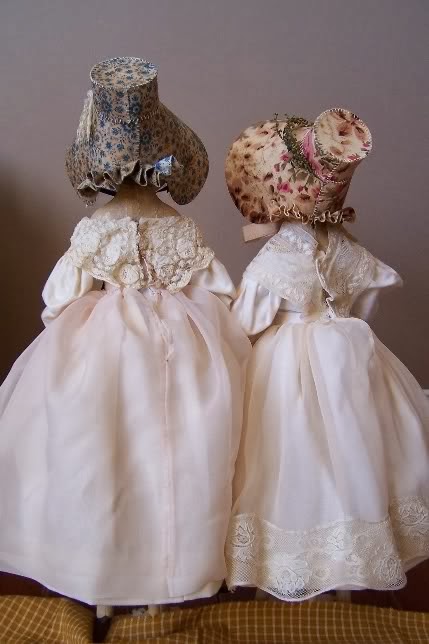
  Could they be sisters? I bet they most certainly could! Here are two of my special early girls. One came with her full original wardrobe, and one came in her birthday suit~ I love them both dearly! I have always admired the early wooden dolls~ especially Queen Anne dolls, but these are a little later in period, and date c18teens to 1820. They are nearly identical in size, but each with special distinctive and very interesting features I will share in details later~ for now, just a little background history, in case you ever wondered what a 'Grodnertal' doll was.
 Pictured above, the Dolomites~ part of the Alps in Northern Italy and SO breathtaking! This is the birthplace of my dollys, and so many others. The Grodner Thal, or Grodner Valley, is home to several wonderful little villages, but the center of doll making was St. Ulrich (Ortesei as known by locals). A very pioneering woman, Amelia B Edwards, came upon St. Ulrich while hiking int he Dolomite Range in the early 1870's and told all about her experience in a book she wrote in 1873, 'Untrodden Peaks and Unfrequented Valleys'. She toured the warehouses while there and reported
" The two largest warehouses in the village are Herr Purger and of Messrs. Insam and Prinoth. They show their establishments with readiness and civility; and I do not know when I have seen any sight so odd and so entertaining. At Insam and Prinoth's alone, we were taken through more than thirty large store-rooms, and twelve of these were full of dolls-- millions of them, large and small, painted and unpainted, in bins, in cases, on shelves, in parcels for exportation"
Can you just imagine what a sight! This was however a view of the toy making there in the mid to late 19th century, after Queen Victoria had helped to make the little precious wooden dolls famous. As with anything that eventually gets mass produced, the quality is directly related to the quantity of manufacture. At the time my dollys were carved, time was spent in getting all their little details perfect~ hands had individually carved fingers, whereas later, in the 1830's, spoon hands with shallow slits for fingers were the norm, then later, just smooth spoon hands with no fingers, until at the turn of the 20th C these poor little dollys had but nubs and blunt ends to their arms, with no differentiated hands at all.
Early dolls were carved with much care, and painted with even more~ very artistically done, and many of the early ones are referred to as 'Portrait type' as their features are so distinct, they must have been done from life, and there are recorded in history Royalty that commissioned dolls to be carved after certain likenesses. Made entirely from wood, the mortise and tenon joints of the early dolls are amazing, and allow for a full range of movement~ dolls were even joined at the waist allowing them to swivel(mine are not). Shoulders, elbows, hips and knees all have nearly 360 degrees of movement! By the time Amelia toured the warehouses in the mid 19th c, the dollys were more quickly and crudely carved to meet the high demand, and had simple joints held with pegs ~ no longer on ball joints, the arms and legs could just move up and down, and the little ones had no joint at the elbow or knees. These came to be affectionately called 'Peg Wooden' dolls. They were also know as 'Penny Wooden' dollys, as they were sold by street vendors, or peddlers, for a penny. Locals would spend all winter carving dolls, and they would be 'distributed' throughout the world by traveling vendors. With the popularity of the high hairstyles of the 1820s & 30s, they were also referred to as "Tuck Comb" dolls, for the comb carved at the top of the head. My dollye on the right above, once had such comb, now long lost to time...or was it? More on that later