Showing posts with label Antique Dolls. Show all posts

Thursday, August 18, 2016

Exploring an 1820 Mache Doll, a final look

Back to that Note......

 So we return to that mysterious note buried within m'Ladys bodice. Its always exciting to find notes on clothing and things~ original notes, from the hands of the owner, and especially when one is not expecting them to be there! This is the difference between buying from a dealer and buying straight from an estate~ one usually gets minimal facts about an object from the latter, they're just interested in selling or liquidating as quickly as possible.

 Once the bodice was unpinned in the back, I easily retrieved the note from behind the cloth covering over the shoulderplate. There is a grubby dirt line on the shoulderplate ~ but all is quite clean and tidy underneath the protection of the bodice, and we can see there is not much fading to the finish overall. The modeling of this Ladye is wonderful and deep~ her collar bone can clearly be seen.

 And if I could take off the cover, would reveal two separately molded breasts as well....but I'm not unpicking the covering, so no need to shield your eyes~

 Beneath the covering is an original period tag, written in ink ~
"Patience" belonged to Mary Ann Forbes Hotchkiss Loaned by Mrs. Hotchkiss 12/28/50. 
The tag here, written by her Mother, Elizabeth in 1850. The child mortality rate was high during this period, and obviously Mary Ann's dolly held a special place of sacred honor in her family after her death in 1839 at the age of 12.
 There is another note stitched to dollys dress, this one reads~

 'doll belonged to Mary Ann Forbes Hotchkiss 1827-1839'

 She is a Grande Ladye too,  standing just a bit over 25" tall, it is difficult to get all of Patience in one picture~

 Her finish is all original, and still as clean and bright as the last day Mary Ann kissed her cheek. Her features are so clean and crisp, she was most definitely one of the first dolls to come from the 3 part mold used to shape her mache head

 Both her pretty ears are exposed, and she retains the deep comb marks of her elaborate molded coiffure. A trio of curls grace each side of her head

 Graceful brush strokes of hair shadow the hairline around her face.

 The deep and artistic sculpting of her features can be appreciated here~ if only Patience could speak~ I am sure she would have some wonderful stories to tell~

Mary Ann resides at the family plot, along with her parents and siblings at the Grove Street Cemetery in New Haven Connecticut~

Thursday, August 11, 2016

Exploring an 1820 Mache Doll

Reattaching m'Lady's Legs

 I have a nice stash of damaged turn of the 20th c kid gloves~ they are great for making doll bodies, clothes, shoes~ and making repairs. They are quite common at flea markets, and can be had for pennies, especially if you ask if they have any singles.

 I picked a dark hunter green kid and cut a wide strip with pinking shears~it needs to cover enough area above and below the join to give the glue a nice foundation to stick to. I will position the kid at the bottom level of the dark blue strip already on the leg, and want it to extend at least a quarter of an inch above the join, so that measure is how wide I cut my strip.

  A bit of cotton padding is carefully inserted between top and bottom leg to cushion and solidify the joint.

 The glue I am using is my staple~ Gane Brothers Yes! Paste. I love this paste~ its acid free and archival, goes on where you want it, and stays there. (This is the same glue I use to mount my embroideries).  A thin layer on the back of the strip is all that is needed~

 It is wrapped around once, being careful to keep the seam to the back. One thing I  love most about this glue is that it grabs immediately~there is no need to sit and hold something forever.  I was also careful not to cover the scallop edge of the earlier strip underneath of it.

 A quick little ribbon bandage tied around to keep all tidy while I attach the other leg the same way. It will get a thin layer of cotton wadding as well at the knee.
 The cotton wadding also helped to adjust her left leg to the correct length~ so standing both her feet touch the floor evenly. (They don't look the same length in the picture because the right leg is up higher than the left on padding). If you are repairing legs like this, you must also be sure to keep the toes off the edge of your surface, and be sure they are pointing forward as the glue dries.

Old legs ready to go walking again! These old kid bodies are so rigid and stiff~ aside from the years of age, the tannins in the wood fill really dry out the kid and make it brittle. They can certainly not be posed in any way!  If I would have attached her legs in line with her upper thighs, her feet would be about 8" apart...so the natural thing would be to grab the thighs and squeeze them together....which would result in two legs broken off at the hips most likely. So I adjusted the angle at attachment, and she does look slightly bow~legged now, but not noticeable at all with her pantaloon on, and standing her feet are nice and straight, and together!

Friday, August 05, 2016

Exploring an 1820 Mache Doll

 But First~ Her Pantaloon!
Long ,lean, and quite grubby...but still, utterly charming. To answer before you all ask~ NO! I will not be washing her clothes. Unless its something horrible or distracting, I never wash any of my antique textiles. To me, doing so removes a certain history of the piece~ the age...the patina. Grubbiness and stains can tell how a piece of clothing was worn...in come cases, can be the only way to determine what was worn as the front or the back of a garment. Here the grubbiness of the bottom of the legs shows what length her gown and chemise were worn at. Fitting to the period, legs are long and straight, reaching down to the ankle. Front is closed, with a full back opening.
 The opening to the back, which extends from waistband to the crotch, closes with a single hook & eye. Note that both edges of the opening are salvedge edges.


 The bottom of her 'trousers' as they could have also been called, are covered in a band of netting. So very plain, yet it makes them ever so much more feminine and delicate.

Wednesday, August 03, 2016

Exploring an 1820 Mache Doll

A Most Uncomfortable Bunching.....

   Underneath her blue petticoat, dollye wears a comfy linen calf length chemise. Here we can see dainty hand stitching at the side seam and hem. In many cases, girls learned how to sew stitching clothes for their dollys~ exactly what they would wear themselves, just smaller.
  Unpinning the top of her dress bodice, just look at what this poor girl has endured for so many years.  This bunching is the sleeve of her chemise...its fullness too bulky to fit down into the bodice's sleeve. I have often thought this would happen in real life, as the armcyes of the gowns in this era are set so far up tight under the armpit...even with full gigot sleeves, the actual arm opening is not large, quite tiny actually. Poor girl~ the chaffing she must have!
 With bodice back open, the chemise can now be seen fully~ there is no front or back opening~ just a really wide boat neck, with no tape ties or drawstring to gather the fullness. Her bodice fits so very tightly, I am not comfortable removing it, so have decided, since I can easily get to the waistband of her pantaloon now, I will leave her bodice and chemise right where they are.
 Pulling back the fullness of the chemise, the bottom of the back cloth torso covering can be seen just above waist level.
 Her chemise is full and loose enough that I can easily unfasten the hammered hook and eye closure at the waistband of her pantaloon.
 Carefully shimmying them down to knee level reveals a clean leg break just above the left knee.
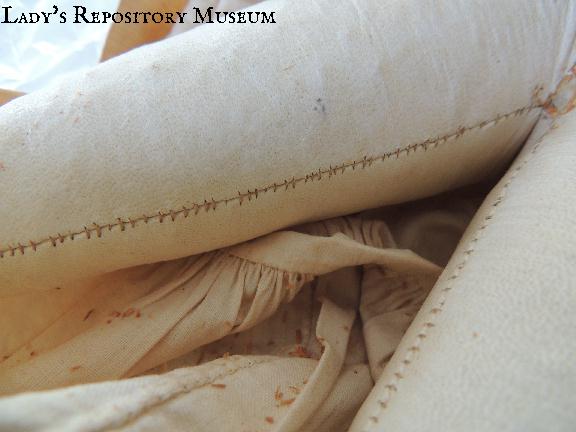
 Her kid body is all hand stitched, and stuffed hard as a rock with wood chips.
 Carefully removing the pantaloon further, reveals that her right leg is literally hanging on by a single tiny bit of leather. The red pinked edge is a paper strip. This covers the joint between the wood leg and kid body. On all the original dollys I have examined, I have only ever found paper over this joint. Our dollye has an added dark blue cloth strip with scalloped edge~ still well down onto the wood of the leg, so I think it is original. Over the top of this, is a blue kid strip, which must have been a period repair.

  Some refer to stuffing in these old bodies as sawdust...but clearly this is far from being 'dust'. Tightly packed in a circular fashion, little wood chips are so absolutely jam packed in there, that thankfully,  hardly any have fallen out.
Her pretty blue shoes with gold decoration on the throats. Now to get these legs back on our girl.....

Thursday, July 28, 2016

Exploring an 1820 Mache Doll

Off with the Apron!
 After removing the petticoat, the pin has been removed from the top neckline of the back opening. A thin muslin cover has been stitched over the bottom of the shoulderplate. Just under the shoulder, wadding can be seen packed tightly up underneath it to fill the gap between shoulderplate and kid body. On top of the muslin  shoulderplate covering, the top of the linen chemise can be seen.
 There are no back closings on the gown at all, it was originally pin'd closed. The blued steel pin in the apron waistband also passes through the bottom of the bodice, so it has to come off next....only it doesnt want to come out. Bluing was a technique (still used today) used to treat bare steel to make it more rust resistant. One must be very careful when removing pins from early textiles, as the rust will grow out into the fibers, and as you try and pull out the pin, you can tear a huge hole in the fabric. I was not able to actually lay my eyes on where the pin was stuck, so gently wiggled it up and down the weeniest little bit, and then twisted it gently to pop it loose.
  The top fullness of the apron is gathered onto the waistband...there are little skye blue puffs of stitching remaining in the waistband.... somewhat puzzling at this point.....
 The waist band is just long enough to reach fully round the waist, there is no extra to tie into a bow.
 The only stitching I can find on the back, other than the waistband and gathering, is tiny whip stitches right at the hem corners. The sides are turned, but not stitched down, and the hem is turned up....but is a raw edge. ::Enter more puzzlement here ::
 As I am examining these three little puffs to the apron edge....I realize they arent lint, but actual stitches....and then as I get out my magnifiers, I can see a zig zag of dots all way round the apron front, these are original stitch holes.
 Now long gone, (most likely from the dye used to color the wool thread),  one can see that the sides and hem of the apron were stitched down from the front with a decorative edging of blue wool
 The same blue wool as these last little bits still in the waistband.
 The blue stitches, combined with her blue petticoat, tell me dolly most likely had another dress, a pretty blue print probably, in her original wardrobe.
Inside the waistband, showing detail of side gathers.  
What will we find next?????

Wednesday, July 20, 2016

Exploring an 1820 Mache Doll

Ah ~ Ha! I knew it!
 I knew I saw something peeking out of her bodice when I saw her sale listing.... ah but its really wedged in there....so we will come back to this later!
 Dolly is fully dressed as a Ladye would have been in the time, so we must carefully remove each layer of her ensemble, to finally reach her bare legs. I have taken off already her caplet/fichu/pelerine and collar, and have turned her on her tummy with toes only extending out past the edge of the counter. One of her legs is fully detached, the other partially, as she is leaking bits from both pantaloon legs. Under her quaint pink print gown, she wears an absolutely marvelous robins egg blue polished cotton petticoat! Her gown is in two pieces, with bodice and skirting separate. Rarely have I seen a period gown of human type that is separate in this era~ but given dolly's milliners type rigid hard stuffed kid body, one would not be able to get the gown on her if it was once piece. Milliner's type bodies are one piece, meaning no joints at the arms or legs, hips or knees or elbows~ they cannot sit poor dears....they stand tall and proud their entire lives.
 The back of the skirting was pin'd closed, so pin was removed and skirting carefully shimmied off. I am careful to not just pull out her legs from the pantaloons, as I do not know the extent of the damage, and am trying to keep as much wood fill in place as I can.  Her petticoat is just marvelous! marvelous marvelous! It has a single hammered hook and eye closure at the waist. The fabric is pleated to a narrow twill tape waistband.
 The cloth is not only polished, but heavily sized and very rigid~ off of dollye it retains her waist shape fully without collapsing.
 When wiggled, it has a very distinct sound....Im trying to place it exactly but cant a the moment....it sounds like heavy paper rustling...or if one has a heavy linen sheet out on the dry line, and the wind blows and snaps it back and forth~ that sound.
 Hook and eye are hammered flat
 Quite a short back opening, I really had to shimmiy this back and forth ever so careful to get it over her behind/hips.
 This is inside the waist, looking down at the front ,  waistband is at the very bottom of the picture.
 Inside hem
Outside hem