Tuesday, August 09, 2016

a Lil Peek at My Flat Top Casket

A minute here.... an hour there....
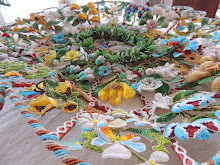
 Summers are so busy its hard to make time to work on something for 'me', so I have to resort to sneaky measures sometimes to get anything accomplished.  I have all of my panels for my flat top framed up on table stands standing tall like little soldiers, patiently waiting for me to stop and work a minute or two. For me, having what I am currently working on out...out on the counter ready to go at a moments notice...is the only way I can squeeze in me time.  If I had to put all up and then drag out everything whenever I felt like stitching....Id really, really, never get anything done! Sometimes I can only stand and stitch maybe 5 or 10 minutes....but before long, those 5 or 10 minutes have added to the 5 or 10 I did the day before and so on........and suddenly, here is a little flitter~fly butterfly staring back at me! I am pleased with how he came out...even dressed in pink, he is a he, and quite a dapper little fellow....
And by little, well, he is little! Here is my fingernail for size~ his wings are wired and can be positioned how ever suits him best. Working with this tiny of antique beads has proved to be quite challenging. I know what I want to make, but no matter how close I get with my magnifiers, its so hard to see, and hardest I have found, is just holding on to the tiny detached pieces while I am working them. Just about a zillion or so more beads, and casket will be finished ;)

Monday, August 08, 2016

Museum Monday!

1865-70 Chemisette/ Corset Cover 59.1999.11
 This week's Museum Monday lucky number is 59!  (If you would like a hand in picking next weeks Museum Monday piece, pick a number between 1-950 and post it in the comment section below!)
 Often referred to as a Chemisette, this week's object is a white cotton corset cover. Just as it's name suggests, it was worn over the corset, and would have had a matching petticoat(s) and or pantaloon.
Short cap sleeves, dropped shoulders and the little stand up collar date it to the late 1860-early 1870's era. Along the front hidden button closure are vertical rows of tucking and machine made  whitework insertion laces.
 Back is cut in one piece with a slight gathering to the wasitband at  center back.
 Both hand and machine sewn, the same wide machine made whitework lace is used on the sleeve cuffs, collar and front of the bodice. All seams are piped.
 Under the central strip of lace on the front is a hidden front button closure~
 Hand worked button holes and pretty carved mother of pearl buttons are a picture of femininity. The edge trim of the wide lace has been left extending out from the center seam down into the waistband~ a very simple detail, but again, it adds to the feminine feel of this piece and gives a real delicate look.
 All of the rows of vertical tucks are machine made~
as are all major construction seams~ sides, waistband and collar, and lace insertions. Looking at the back (I left large so you can click to see the details), all raw edges have additionally been whipped by hand. I like to use this piece as a perfect example of how machines were used in early years for the basic construction of a piece, but then details and finishing were still patiently, and expertly done by hand. 

Friday, August 05, 2016

Exploring an 1820 Mache Doll

 But First~ Her Pantaloon!
Long ,lean, and quite grubby...but still, utterly charming. To answer before you all ask~ NO! I will not be washing her clothes. Unless its something horrible or distracting, I never wash any of my antique textiles. To me, doing so removes a certain history of the piece~ the age...the patina. Grubbiness and stains can tell how a piece of clothing was worn...in come cases, can be the only way to determine what was worn as the front or the back of a garment. Here the grubbiness of the bottom of the legs shows what length her gown and chemise were worn at. Fitting to the period, legs are long and straight, reaching down to the ankle. Front is closed, with a full back opening.
 The opening to the back, which extends from waistband to the crotch, closes with a single hook & eye. Note that both edges of the opening are salvedge edges.


 The bottom of her 'trousers' as they could have also been called, are covered in a band of netting. So very plain, yet it makes them ever so much more feminine and delicate.

Wednesday, August 03, 2016

Exploring an 1820 Mache Doll

A Most Uncomfortable Bunching.....

   Underneath her blue petticoat, dollye wears a comfy linen calf length chemise. Here we can see dainty hand stitching at the side seam and hem. In many cases, girls learned how to sew stitching clothes for their dollys~ exactly what they would wear themselves, just smaller.
  Unpinning the top of her dress bodice, just look at what this poor girl has endured for so many years.  This bunching is the sleeve of her chemise...its fullness too bulky to fit down into the bodice's sleeve. I have often thought this would happen in real life, as the armcyes of the gowns in this era are set so far up tight under the armpit...even with full gigot sleeves, the actual arm opening is not large, quite tiny actually. Poor girl~ the chaffing she must have!
 With bodice back open, the chemise can now be seen fully~ there is no front or back opening~ just a really wide boat neck, with no tape ties or drawstring to gather the fullness. Her bodice fits so very tightly, I am not comfortable removing it, so have decided, since I can easily get to the waistband of her pantaloon now, I will leave her bodice and chemise right where they are.
 Pulling back the fullness of the chemise, the bottom of the back cloth torso covering can be seen just above waist level.
 Her chemise is full and loose enough that I can easily unfasten the hammered hook and eye closure at the waistband of her pantaloon.
 Carefully shimmying them down to knee level reveals a clean leg break just above the left knee.
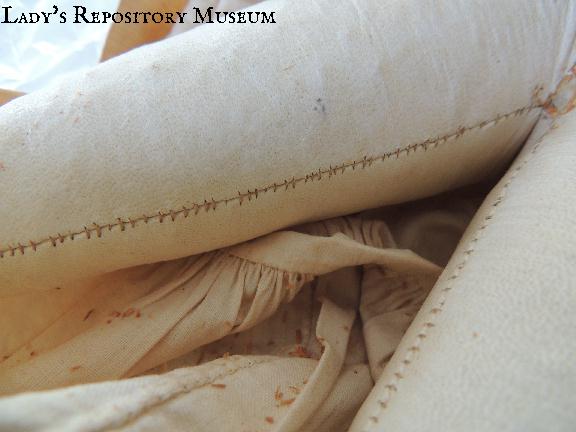
 Her kid body is all hand stitched, and stuffed hard as a rock with wood chips.
 Carefully removing the pantaloon further, reveals that her right leg is literally hanging on by a single tiny bit of leather. The red pinked edge is a paper strip. This covers the joint between the wood leg and kid body. On all the original dollys I have examined, I have only ever found paper over this joint. Our dollye has an added dark blue cloth strip with scalloped edge~ still well down onto the wood of the leg, so I think it is original. Over the top of this, is a blue kid strip, which must have been a period repair.

  Some refer to stuffing in these old bodies as sawdust...but clearly this is far from being 'dust'. Tightly packed in a circular fashion, little wood chips are so absolutely jam packed in there, that thankfully,  hardly any have fallen out.
Her pretty blue shoes with gold decoration on the throats. Now to get these legs back on our girl.....

Monday, August 01, 2016

Museum Monday!

1830 Girl's Roller Print Apron 300.2005.11
 This week's Museum Monday lucky number is 300! Sized for a toddler, this little apron is just about as precious as one could ever imagine. Aprons were an integral part of the 18th & 19th c wardrobe~ along with pinafores, they helped to keep the gown underneath clean. Such utilitarian  pieces of clothing just did not survive~ when Mommy's apron wore out, it was cut down for daughter to wear, or used for household rags and bandages. If it was made from a pretty print or silk, it could have the good sections cut out and used for quilt or pocket patchwork. Indeed, being able to share this rare survivor with you is an absolute joy, for not only is the apron beautifully and artfully contrived, but the shoulder straps are still attached!  It's hand stitched from a lightweight border print muslin, with two front pockets and pointed shoulder straps.
 Each shoulder strap is made up of a single large triangle. With the orientation of the printed border and corner motifs, along with the small size of the apron as a whole (measure from top of  waistband to hem is just 13"), I believe it to be cut from a large kerchief or possibly a head covering, such as a turban. Cloths printed for use as head wraps were very popular in the late teens and twenties.  There is a little blush pink silk bow atop each shoulder.
 The brown areas of the design have been cylinder printed with blue areas on the seashells either block printed or penciled on by hand.
A precious, wonderful scrap of cylinder, (or roller) printed cotton was used for the outside of the waistband~ its lined in plain muslin and pins closed in the back. This same print also was used for the piping that edges the pockets.
A common problem with fabrics printed using iron mordants is pattern loss such as above~ if you look closely you will see holes where the fabric has totally disintegrated away where the brown has been printed onto the fabric.
A technique known as Broiderie Perse was used to decorate both pockets. It was very popular in the early to mid 19th c for making quilts and coverlets. Motifs were carefully cut from a fancy pattern'd cloth, usually chintz, and then rearranged and appliqued onto a backing.
Perfect tiny and close stitches have kept the edges of the appliques from raveling or lifting. The little girl who once wore this quaint but beautiful apron was surely the envy of all her piers!

Friday, July 29, 2016

Flemish Fantasy Kit update

Kits in Stock Again!

The response I have received for my 2016 Flemish Fantasy Ornament Kit has been wonderful~ well beyond my expectations. To my super fantastic customers who have been patiently waiting their kit to be shipped, they have all gone out this morning~ so please check your email for your specific tracking number. I have really tried to keep them in stock, really I have~ and it never fails when I get down low and reorder my silks, I will get orders in that inbewteen time that have to wait to ship~ so I do sincerely apologize to those of you who I could not ship out your kit the same day you ordered one. I have fourteen left sitting here, ready to ship out if you have been pondering getting one!  You can find ordering info for them here .

Thursday, July 28, 2016

Exploring an 1820 Mache Doll

Off with the Apron!
 After removing the petticoat, the pin has been removed from the top neckline of the back opening. A thin muslin cover has been stitched over the bottom of the shoulderplate. Just under the shoulder, wadding can be seen packed tightly up underneath it to fill the gap between shoulderplate and kid body. On top of the muslin  shoulderplate covering, the top of the linen chemise can be seen.
 There are no back closings on the gown at all, it was originally pin'd closed. The blued steel pin in the apron waistband also passes through the bottom of the bodice, so it has to come off next....only it doesnt want to come out. Bluing was a technique (still used today) used to treat bare steel to make it more rust resistant. One must be very careful when removing pins from early textiles, as the rust will grow out into the fibers, and as you try and pull out the pin, you can tear a huge hole in the fabric. I was not able to actually lay my eyes on where the pin was stuck, so gently wiggled it up and down the weeniest little bit, and then twisted it gently to pop it loose.
  The top fullness of the apron is gathered onto the waistband...there are little skye blue puffs of stitching remaining in the waistband.... somewhat puzzling at this point.....
 The waist band is just long enough to reach fully round the waist, there is no extra to tie into a bow.
 The only stitching I can find on the back, other than the waistband and gathering, is tiny whip stitches right at the hem corners. The sides are turned, but not stitched down, and the hem is turned up....but is a raw edge. ::Enter more puzzlement here ::
 As I am examining these three little puffs to the apron edge....I realize they arent lint, but actual stitches....and then as I get out my magnifiers, I can see a zig zag of dots all way round the apron front, these are original stitch holes.
 Now long gone, (most likely from the dye used to color the wool thread),  one can see that the sides and hem of the apron were stitched down from the front with a decorative edging of blue wool
 The same blue wool as these last little bits still in the waistband.
 The blue stitches, combined with her blue petticoat, tell me dolly most likely had another dress, a pretty blue print probably, in her original wardrobe.
Inside the waistband, showing detail of side gathers.  
What will we find next?????