Sunday, July 29, 2012
EAL 5th Anniversary Sale & eBay Specials!
New eBay Specials & ETSY SALE!
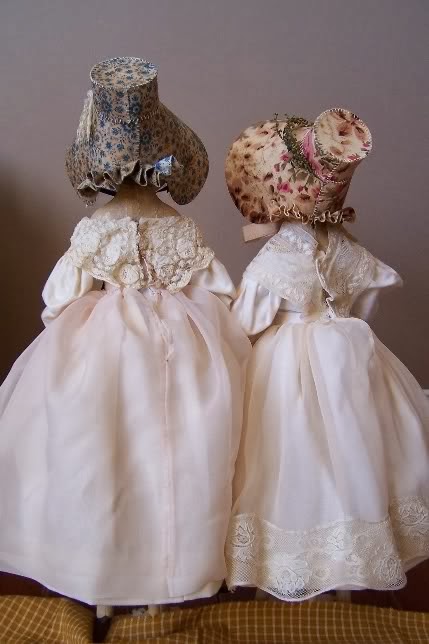
 Isn't she precious? You can find Hera on eBay this week, along with other special chosen dollys and whatnots to celebrate my 5th consecutive year being chosen for Early American Life Magazine's Directory of Top 200 American Craftsmen! And I'm not just celebrating on eBay...... EVERYTHING in my ETSY store THIS WEEK, is 35% OFF~ all you have to do is enter the coupon code EAL2012 at your checkout!

Monday, July 23, 2012
An 1840 Fondue.....
 No. Not the eating variety. Everyone so enjoyed Mary's bottle green silk gown I posted earlier, I thought that I would share this one with you too~ as early prints are my absolute favorites....and of coarse, my favorite colors are blue and brown, so this c1840 fan front printed cotton dress is very dear to my heart and I know you will enjoy it as well.
The fan front was a cunning use of optics that the dressmakers utilized to make our waists look smaller~ the close tight gathers at the base of the fan, elongate the torso and draw ones eye downward, taking the focus off the horizontal width of the waist and placing it at the center where the gathers are.
 As you can see from the side, the waist is actually quite broad, nearly in line with the width of the shoulders.
 Wonderful piping is another detail of early handwork that I, personally, dont think a person could ever over~do. I love piping. The waist is 'gauged', meaning tiny perfectly evenly spaced gathers, each stitched to the waistband with a single perfect little whip stitches.
 Narrow pagoda shape sleeves, I would say 3/4 length~ white mull undersleeves would have been worn underneath to cover the arm to the wrist.
 Back closure of hidden brass hook and eyes~ by hidden I mean set back from the edge about an inch, so when fastened, there is a flap of fabric that covers them keeping ones back nice and tidy and totally covered!
 Of coarse all is stitched by hand in weensie little stitches. I have a couple other childrens gowns in similar really vibrant Prussian blue ombre prints~ the period correct term for the shading of light to dark is fondue. I love fondue...and this type has no calories ;)
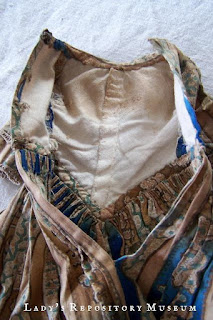 Inside the bodice is lined with a single center busk pocket. The skirting is unlined.
 The back is a little more vibrant than the front, but overall, there is not so much fading. These electric blues were all the rage in 1840s and early 1850s.
 The fondue prints were highly prized for their shaded colors, and offered quilt makers nearly an entire palette of colors to choose from in just one fabric~ by the way they cut the pieces, all different looks could be achieved. Many gowns like this one ended up cut up into pieces for patchwork and applique quilts, making actual surviving garments of fondue printed cottons somewhat uncommon
 Size? Well, as you can see, this is an even more extra special dress, as it is a mere 12" from shoulder to hem, sized for a very special dolly. One has to wonder, if her Ladye Pet had one to match......

The fan front was a cunning use of optics that the dressmakers utilized to make our waists look smaller~ the close tight gathers at the base of the fan, elongate the torso and draw ones eye downward, taking the focus off the horizontal width of the waist and placing it at the center where the gathers are.


Thursday, June 28, 2012

Sunday, June 24, 2012

Tuesday, June 19, 2012
So Commonly Rare...
 Trevette asked me a while ago if I would share some of the early mitts here at the Museum on the blog, so I chose a few this morning, of my most prized and rare examples for your pleasure. You will find no fancy silk mitts here today, no colorful embroidery...no initials or love sentiments...just wonderful early linen mitts and gloves the ladies, both young and olde, wore everyday. This first pair are for a young lady, and as you can see, have points that fold back over the back of the hand. From the fold, to the back edge, they measure 11" long....which actually, is the measure of the back of my own hand to my elbow....so why do I think these are for a young girl you ask? The wrist is a scant 4& half inches in circumference. There is no opening at the palm of the hand or inner wrist like on late 19th c gloves, so one's hand must be small enough to fit thru the narrowest part of the mitt's sleeve.
 The tip of the thumb is open, and there are 3 lines of decorative stitching at the back of the hand, ending at the foldover seam. These early gloves were stitched from fabric cut on the bias so they would be more flexible and fit to the arm better. In the 18th c it was common & fashionable to have the points that folded back over the hand. One could protect their skin from the sun, and yet still have their fingers free to do needlework, hold a tea cup ect.
 Please do click on the pictures to enlarge them~ the stitching is amazingly tiny, its very hard to see individual stitches with the nekkid eye!
 The thumb is set in deep, and is cut in a curve to follow the thumbs natural position and not have bulky wrinkles. Note the darn center front here~ one reason everyday linen gloves are so very, very rare to find, in single or in pair, is that they were indeed worn every day, and were subject to alot of stress...literally worn to bits. In fact, the match to this one I have not padded, as the palm has worn so very thin it is transparent.
 There is a join in the fabric that runs from the "i" in Repository up to the tip of the inner thumb~ one of 7 such joins on this mitt
 Here you can see the triangular flap folded over. These were worn by Mary Wistar, born 27 Nov. 1765 in Philadelphia. Due to the size, she most likely wore them around 1775-80. She was not a small woman, as these were obtained with many other items of her wardrobe, so I could be stretching the date a little.
 This cunning pair of fingerless mitts are for a small child, and measure a scant 9" from end to end. They are made of extremely fine linen, with drawstrings around the arm edge.
 Cut to fit straight across the back of the hand at the knuckles, and without fitted thumbs, just finished openings, both of which have stress related tears at the outside thumb edge.
 Here you can see the size comparison ~ the fold over mitts are to the far right in the above photo, the childs across the top. The single mitt to the far left, and the pair of gloves in the center, were worn by Mary B. Decon in 1794.
 The single mitt is of paper thin cambric~ you can see the thumb placement is similar to Mary Wistar's mitts, with the thumb ending even with the front hem~ this would cover the thumb up to the knuckle.
 The stitching on the back of the hand
 There is no rule that all mitts need have points, or a certain date range for one having or not having them, it was personal preference.....and depended if the wearer followed the fashion trends or not. These too are cut on the bias, as they all are, but they have a simple fold over cuff with no drawstring at the elbow end.
 The gloves are my favorite, for too many reasons to list. They are very fragile and have several places in the fingers where the cambric has worn to beyond paper thin....but they also have darn after darn....both top thumb seams have been stitched over a few times...perhaps Mary had long nails that wore them out? Here you can see the stitching at the back of the hand, along with those awesome finger gussets!


 This engraving is from 1766, note the young woman's fold back mitts....tres fashionable!

In this plate from 1784 you can clearly see the fitted thumb and open fingers of her green silk mitts as she delicately wields her scissors in one hand, and lace in the other.


The drawstring at elbow hem to keep them up on the arm~

In this fashion plate from 1803 you can see the gloves tie well above the elbow. (dont forget to click on it to make it larger)


In this plate from 1784 you can clearly see the fitted thumb and open fingers of her green silk mitts as she delicately wields her scissors in one hand, and lace in the other.
Friday, June 08, 2012

Tuesday, June 05, 2012
Girl's Bottle Green Silk dress, 1841


From clues on the tag, this dress belonged to and was worn by Mary Merrill Morse Rice in 1841 when she was indeed, 7 years old.


Here are some close views of the front and back gauging Sherri~ be sure and click on the pictures, I left them BIG so you can try and appreciate the details.


Subscribe to:
Posts (Atom)